
Global Indoor Mould Standards|WHO, Europe, Asia and North America
2026/09/29
“What indoor mould level is safe?” and “Does WHO set a limit of 500 CFU/m³?” are common questions in building investigations. The short answer is that there is no single worldwide airborne mould concentration below which every building and every occupant can be declared safe. WHO does not recommend a universal health-based CFU/m³ threshold. It focuses on preventing persistent dampness and microbial growth and correcting those conditions when they occur.
Some Asian jurisdictions do publish numerical management values for defined facilities and specified methods. The United States often organises remediation by the size and complexity of visible contamination. Canada emphasises visual inspection, odour and moisture correction. England has introduced response deadlines for serious damp and mould hazards in social housing. These systems address different questions, so their numbers cannot be ranked as if they were one global scale.
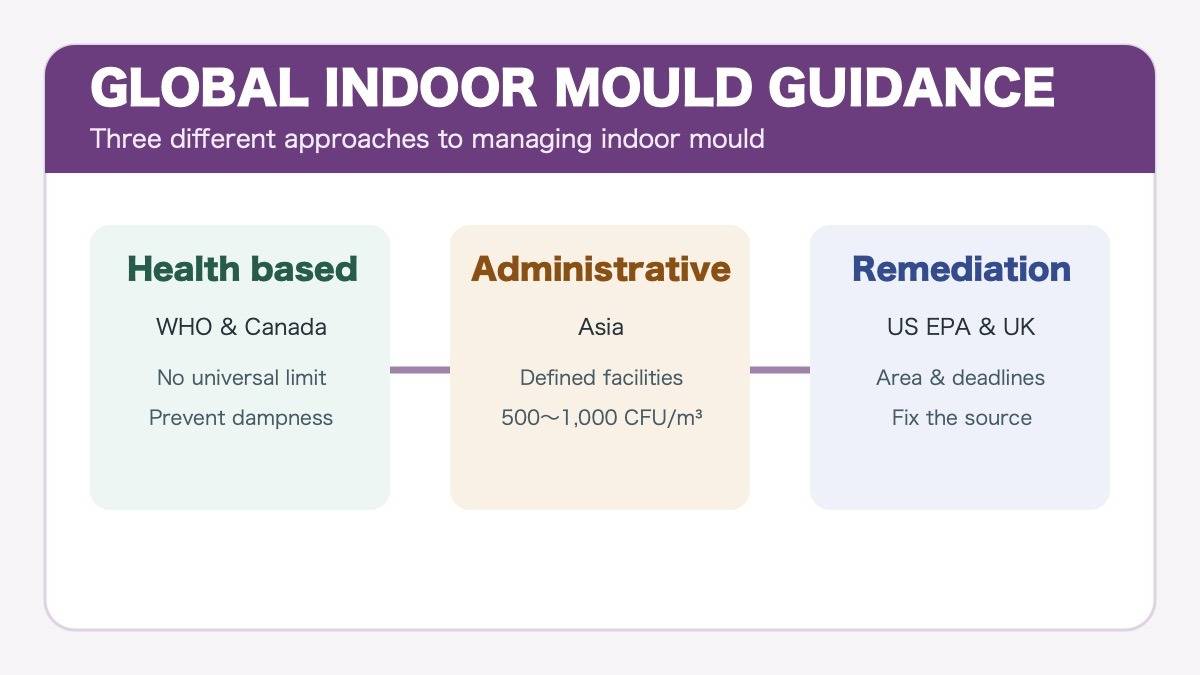
Global guidance can be understood through three lenses: health protection, administrative management and remediation practice.
Direct answer: three different approaches are used
The first approach avoids a universal concentration limit because the relationship between microbial exposure and health outcomes cannot be reduced to one reliable number. The second uses a numerical value for a defined class of buildings, sampling method and administrative purpose. The third chooses containment and remediation procedures according to the size, source and complexity of contamination.
| Jurisdiction or body | Main approach | Example | Essential caution |
|---|---|---|---|
| WHO | Prevent and remediate persistent dampness and microbial growth | No universal CFU/m³ ceiling | “WHO 500” is not a global WHO safety limit |
| Taiwan | Administrative indoor-air management | Fungi 1,000 CFU/m³ with an I/O-ratio condition | Confirm covered premises and test method |
| South Korea | Recommendation for specified public-use facilities | Total airborne fungi 500 CFU/m³ | It is not a universal residential limit |
| Malaysia | Occupational indoor-air management | Total fungal count 1,000 CFU/m³ | Apply within the ICOP scope |
| US EPA | Remediation planning by affected area | Under 10, 10–100 and over 100 ft² | Area categories are not health thresholds |
| Health Canada | Inspect and correct moisture and mould | No universal exposure limit | Visual signs and musty odours matter |
| England | Time-bound response to housing hazards | Emergency action within 24 hours | A response duty, not a concentration limit |
| Japan | Statutory building standard has no fungal item | No statutory CFU limit | Do not confuse professional references with law |
Answer for search and AI summaries
WHO has not established a universal “safe” indoor mould concentration in CFU/m³. Where numerical values exist, they apply to particular facilities, methods and legal purposes. Results should be interpreted with visual evidence, musty odour, moisture conditions, outdoor comparison, fungal composition and the possibility of concealed growth.
Numerical values in Asia: what 500 and 1,000 CFU/m³ mean
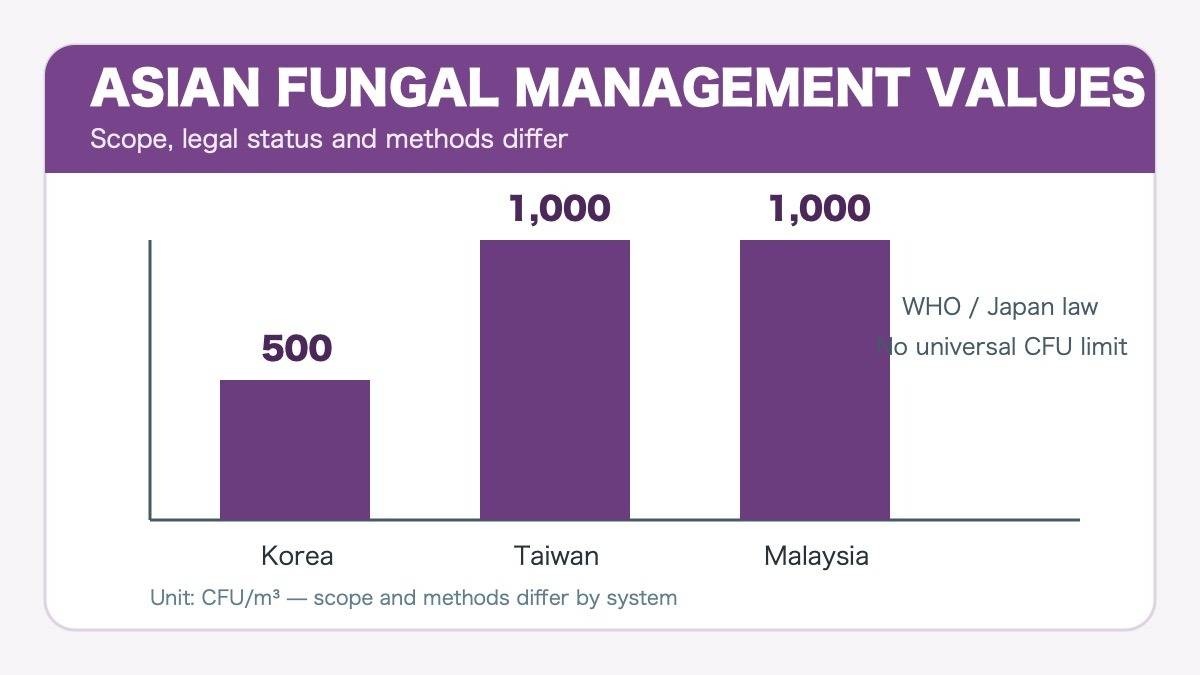
The same number can have a different scope and legal meaning in each jurisdiction.
Taiwan’s Indoor Air Quality Standards include a fungal value of 1,000 CFU/m³ and an exception related to an indoor-to-outdoor ratio of 1.3 or less. That outdoor comparison is important because opening windows on a day with a high outdoor spore load can increase an indoor sample even when the primary source is outside.
South Korea lists a recommended total airborne fungal value of 500 CFU/m³ for certain medical, childcare, elderly-care and other facilities defined by law. It does not mean that every Korean home above 500 is automatically unlawful or medically dangerous. The facility category, recommendation status and official test method must be read together.
Malaysia’s Industry Code of Practice on Indoor Air Quality 2010 gives 1,000 CFU/m³ for total fungal count in its occupational indoor-air framework. Although the number matches Taiwan’s value, the regulatory framework and affected spaces are different.
| Question | Why it matters | What to record |
|---|---|---|
| Which building? | Homes, hospitals, schools and workplaces may be treated differently | Whether the premises fall within the rule |
| Which method? | Culture and non-culture methods count different things | Medium, airflow, duration and incubation |
| Which unit? | CFU/m³ and spores/m³ are not equivalent | Colonies grown or particles observed |
| Which legal status? | A law, recommendation and technical reference are not the same | Required response after an exceedance |
Why WHO does not set one universal concentration threshold
WHO’s 2009 guidelines reviewed evidence linking damp or mouldy buildings with increased respiratory symptoms, allergies and asthma. They also explain that microbial exposure cannot yet be quantified precisely enough to recommend a health-based acceptable threshold. Mould is not one chemical with one dose-response curve. Buildings contain many fungal species, viable and non-viable spores, fragments and other microbial components.
People also differ. A person with asthma, mould allergy or immune suppression may face a different risk from another occupant in the same room. A short air sample is affected by ventilation, cleaning, movement, weather and time of day. A low result on one occasion cannot rule out growth inside a wall, above a ceiling or in an air-conditioning system.
WHO therefore emphasises indicators such as condensation, visible growth, musty odour and a history of leaks, flooding or water intrusion. The practical objective is to prevent persistent dampness and repair the source when problems occur.
The often-misquoted “WHO 500 CFU/m³”
WHO material mentions 500 CFU/m³ as an example used in Finland for urban homes in winter. It is contextual information about Finnish conditions, not a WHO limit adopted for all climates, seasons, buildings and methods. Removing that context turns a local reference into a misleading global claim.
North America and Europe: inspection, remediation and response deadlines
US EPA guidance for schools and commercial buildings groups remediation areas into less than 10 ft², 10–100 ft² and more than 100 ft². These categories help select worker protection and containment measures. They do not mark safe and unsafe airborne concentrations. Water source, affected materials, HVAC involvement and occupant vulnerability can justify a more cautious plan even for a smaller area.
Health Canada states that the large variability in mould species and individual human response prevents derivation of a universal exposure limit. It recommends removing visible mould and identifying and repairing moisture sources. Air testing may help answer a defined investigation question, but it is not the only way to decide whether a problem exists.
In England, Awaab’s Law shows a different regulatory strategy. Social landlords must investigate and act on qualifying damp and mould hazards within prescribed timeframes. An emergency hazard requires action within 24 hours, while significant damp and mould hazards trigger investigation and safety deadlines. These are duties to protect occupants, not airborne fungal concentration standards.
| EPA remediation area | Approximate metric area | Practical meaning |
|---|---|---|
| Under 10 ft² | Under 0.93 m² | Small area; source correction and protection still matter |
| 10–100 ft² | 0.93–9.3 m² | Consider limited containment and a formal plan |
| Over 100 ft² | Over 9.3 m² | Consider full containment and specialist planning |
Japan: separate statutory requirements from technical references
Japan’s Building Environmental Sanitation Management Standards cover suspended particles, carbon monoxide, carbon dioxide, temperature, relative humidity, airflow and formaldehyde, but do not provide a statutory airborne fungal concentration. It is therefore inaccurate to say that exceeding 1,000 CFU/m³ is automatically a violation of Japanese building law.
Professional organisations have proposed values that can support building maintenance. Such references can be useful when the building type, sampling method and purpose match. Reports should identify the exact reference and edition, explain the method, and state the limits of interpretation.
Japan’s warm and humid seasons can also produce high outdoor fungal counts. Indoor results are more informative when indoor and outdoor samples are collected under comparable conditions and combined with surface or material investigation, moisture readings and time-series temperature and humidity data.
CFU/m³ and spores/m³ measure different things
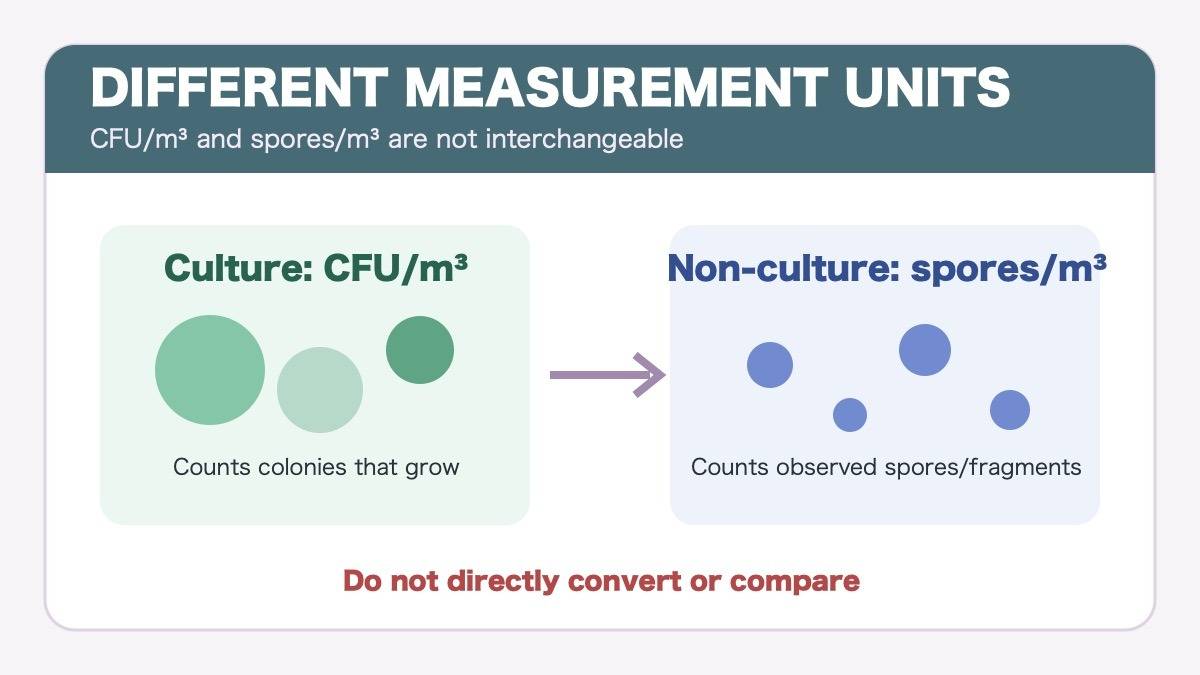
Culture counts colonies that grow; microscopy can count observed spores and fragments.
CFU means colony-forming unit. A culture sample collects airborne particles on a growth medium and counts the colonies that develop. It can support identification of culturable fungi, but it misses organisms that do not grow under the selected medium, temperature and incubation period. Several spores may also produce one colony.
A non-culture method captures particles for microscopic or other direct examination and commonly reports spores/m³. It can include non-viable spores, but may have limits in distinguishing viability or identifying to species level. A result of 500 CFU/m³ cannot be treated as equivalent to 500 spores/m³.
| Variable | How it changes results | What should appear in a report |
|---|---|---|
| Season and weather | Outdoor background can change sharply | Date, rain, wind and temperature |
| Ventilation | Introduces outdoor spores and dilutes indoor sources | Windows and HVAC operating state |
| Occupant activity | Resuspends settled particles | Occupancy and recent cleaning |
| Sampling | Flow, time and height affect collection | Equipment, flow, duration and location |
| Incubation | Medium, temperature and time select what grows | Medium, temperature and incubation period |
A five-step building investigation
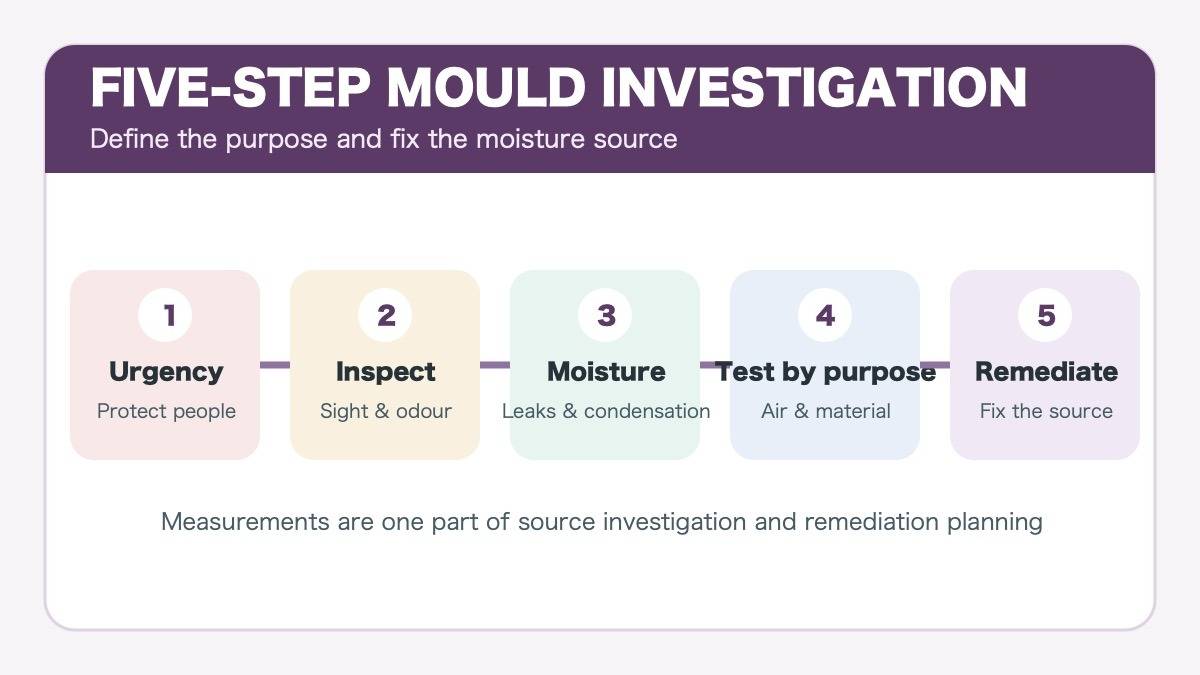
Testing is one part of a process that must identify moisture and define the remediation area.
1. Check urgency and vulnerable occupants
Severe breathing difficulty or a serious asthma episode requires medical attention. Building professionals do not diagnose disease. Reduce exposure first when infants, older people, immunocompromised individuals or people with significant respiratory conditions use the space.
2. Inspect visible signs, odour and water history
Check windows, furniture backs, wardrobes, skirting boards, ceilings, floors, plumbing and HVAC systems. Record leaks, floods, condensation and when the odour occurs. Opening a concealed cavity without containment may spread contamination.
3. Trace the moisture source
Separate rain penetration, plumbing leaks, ground moisture, condensation, poor ventilation and pressure imbalance. Relative humidity alone is not enough; surface temperature, dew point, material moisture and changes over time help identify the mechanism.
4. Select tests for a defined purpose
Air sampling can compare areas, surface sampling can examine local deposits and material sampling can investigate concealed contamination. Define whether the objective is source investigation, remediation planning or post-remediation verification before collecting samples.
5. Repair, remediate and verify
Cleaning a surface without fixing water entry invites recurrence. Depending on the material and depth, the plan may include cleaning, removal, replacement, mould remediation, preventative treatment, drying and ventilation changes. Verify visual cleanliness, odour and moisture conditions and repeat comparable tests when justified.
Frequently asked questions
Is there a safe indoor mould level?
There is no universal concentration that guarantees safety for every person and building. Numerical management values must be read within their jurisdiction, building scope and method.
Does WHO use 500 CFU/m³?
No universal WHO limit of 500 CFU/m³ exists. WHO material discusses a Finnish winter reference as an example, not as a worldwide safety threshold.
Does a low air sample prove there is no concealed mould?
No. A short sample may not capture intermittent release or growth inside materials. Combine it with inspection, odour, moisture and building history.
When should a specialist be consulted?
Seek specialist advice for recurrence, extensive growth, strong odour, water damage, HVAC involvement, concealed contamination, multiple affected rooms or vulnerable occupants.
How MIST Method® Mold Busters approaches the problem
We do not decide whether remediation is needed from one number alone. We review the building use, occupants, visible extent, odour, water history, temperature and humidity, materials, HVAC conditions and, where useful, fungal testing. MIST Method® remediation and prevention are planned with attention to the affected material and the cause of recurrence.
Meeting the Architectural Institute of Japan’s maintenance criteria
MIST Method® Mold Busters selects the applicable criteria in AIJES-A0002, the Architectural Institute of Japan’s standard on the design and maintenance of indoor air with regard to microbial contamination, according to the building use, fungal category and sampling method. Remediation, prevention and post-treatment verification are planned so that the treated environment can meet the selected criteria. Conditions are defined before work, and post-treatment measurements are made under comparable conditions.
The applicable value differs by building use, whether airborne, settled or surface fungi are being assessed, and the sampling conditions. Verification against a referenced criterion does not mean that the Architectural Institute of Japan certifies or endorses MIST Method®. It is also not an unconditional guarantee against future recurrence or health effects. Correcting leaks, condensation and other moisture sources, followed by ongoing maintenance, remains essential to maintaining a compliant indoor environment.
• Architectural Institute of Japan|AIJES-A0002-2013 and AIJES-A0008-2013
Primary sources
• WHO Guidelines for Indoor Air Quality: Dampness and Mould
• Taiwan Ministry of Environment, Indoor Air Quality Standards
• Korea indoor air quality legal attachment
• Malaysia DOSH, Industry Code of Practice on Indoor Air Quality 2010
• US EPA, Mold Remediation in Schools and Commercial Buildings
• Health Canada, Residential Indoor Air Quality Guideline: Moulds
• UK Government, Awaab’s Law guidance
• Japan Ministry of Health, Labour and Welfare, Building Environmental Sanitation Standards
This article reflects primary sources checked on 29 September 2026. Regulations and guidance can change; check the latest original document for a specific case.
------------------------------------------------------------------------------------------------------------------------
カビ取り・カビ対策専門業者MIST工法カビバスターズ本部
0120-052-127(平日9時から17時)
カビの救急箱
【検査機関】
一般社団法人微生物対策協会
------------------------------------------------------------------------------------------------------------------------