
Mould in Japanese Homes: Why It Happens, Who Pays, and Where to Get Help in English
2026/08/13
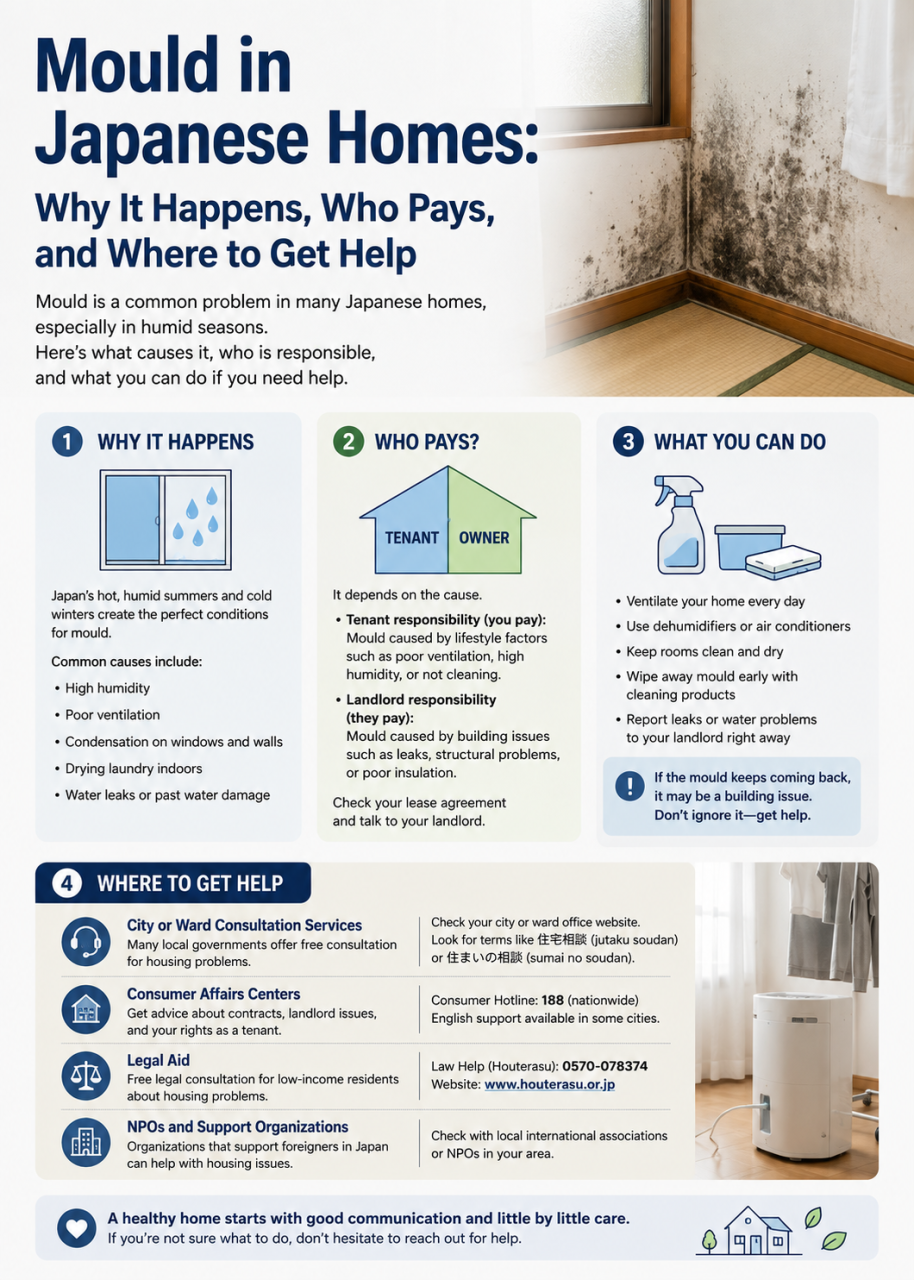
If you have moved to Japan from another country, finding black spots on a wall, a musty smell inside a closet, mould around a window, or dampness behind furniture can be confusing. You may be cleaning regularly and using the air conditioner, yet the mould keeps returning.
The first thing to understand is that mould in a Japanese home is not always simply a cleaning problem.
Japan’s climate, seasonal humidity, condensation, ventilation conditions and the construction of the building can combine to create moisture in places that are difficult to see. Closets, tatami rooms, north-facing walls, areas behind furniture, wall cavities, ceilings and underfloor spaces can retain moisture or experience condensation. Project materials also identify moisture stagnation, temperature differences and insufficient ventilation as important factors to investigate when mould repeatedly develops in Japanese homes.
This is why wiping mould from the visible surface may not solve the underlying problem.
Think of mould like a warning light on a car dashboard. Removing the visible mould is similar to switching off the warning light. What really matters is finding out why the warning appeared in the first place.
In modern buildings, the source of moisture may be different from the location where the mould becomes visible. Condensation, water intrusion, insufficient ventilation, moisture retained inside construction materials, or airflow imbalance may all need to be considered. If the underlying cause remains, the risk of mould returning may also remain.
At MIST工法®カビバスターズ, we therefore place importance on investigating the conditions behind the mould problem before deciding what action is appropriate.
Depending on the property, our investigation may include visual inspection, measurement of moisture levels in building materials, inspection inside walls using a fibre scope, and airflow or pressure checks using airflow measuring equipment. These methods can help identify moisture, hidden building conditions and ventilation imbalance that cannot be understood simply by looking at the surface. Our project materials specifically include moisture measurement, fibre-scope investigation and airflow/pressure measurement as part of the approach to identifying hidden causes.
We also recommend considering fungal testing when the extent or source of a mould problem is unclear. MIST工法®カビバスターズ works in cooperation with the General Incorporated Association for Microbial Control(一般社団法人微生物対策協会) to help assess mould conditions more objectively.
This can be particularly useful when mould keeps returning, when there is a persistent musty smell but little visible mould, or when you want clearer information about the indoor environment before deciding what to do next. Professional fungal testing can add information that visual inspection alone cannot provide.
Another major concern for foreign residents is:
“Who has to pay for mould damage in a rented apartment in Japan?”
There is no correct answer based only on the fact that mould exists.
Japan’s Ministry of Land, Infrastructure, Transport and Tourism provides the Guidelines for Troubles Concerning Restoration to Original Condition(国土交通省「原状回復をめぐるトラブルとガイドライン」)to help clarify the general division of responsibility between landlords and tenants.
The guidelines distinguish deterioration associated with normal use and ageing from damage caused by a tenant’s negligence or failure to take reasonable care. They also give examples in which mould or stains that expanded because condensation was left unattended may become the tenant’s responsibility. At the same time, mould can also be associated with building conditions, so responsibility should not be decided simply by seeing mould on a wall. The cause, the tenancy agreement, how the property was used, whether the problem was reported, and the condition of the building all need to be considered.
For this reason, when a tenant, landlord, property manager or relocation company disagrees about mould responsibility, identifying why the mould developed can be just as important as removing it.
Photographs alone may show the result, but they do not always establish the cause.
Moisture readings, inspection of concealed areas, ventilation assessment and fungal testing can provide additional information for discussing what is happening inside the property. This is especially important before repeatedly replacing wallpaper or carrying out cosmetic repairs without first identifying the source of moisture.
For foreign residents, dealing with a mould problem can also be difficult because the landlord, property management company, construction company and mould specialist may all communicate primarily in Japanese.
MIST工法®カビバスターズ accepts enquiries from English-speaking residents and organisations in Japan.
We support mould-related enquiries throughout Japan, including houses, apartments, company housing and other properties. If the problem is too extensive to handle yourself, if mould returns after cleaning, if there is a strong musty smell, or if you suspect moisture or mould may be hidden inside the building, please contact us before simply repeating surface cleaning.
Our goal is not only to look at the mould you can see.
We investigate why it developed, where the moisture is coming from, and what environmental or building conditions should be addressed to reduce the risk of recurrence.
If you are worried about mould in your home in Japan and do not know where to start, an inspection and fungal assessment can provide a much clearer starting point.
English enquiries are welcome. MIST工法®カビバスターズ provides mould investigation support nationwide across Japan.
Before asking only, “How can I remove this mould?”, start with the more important question:
“Why is mould growing here?”
目次
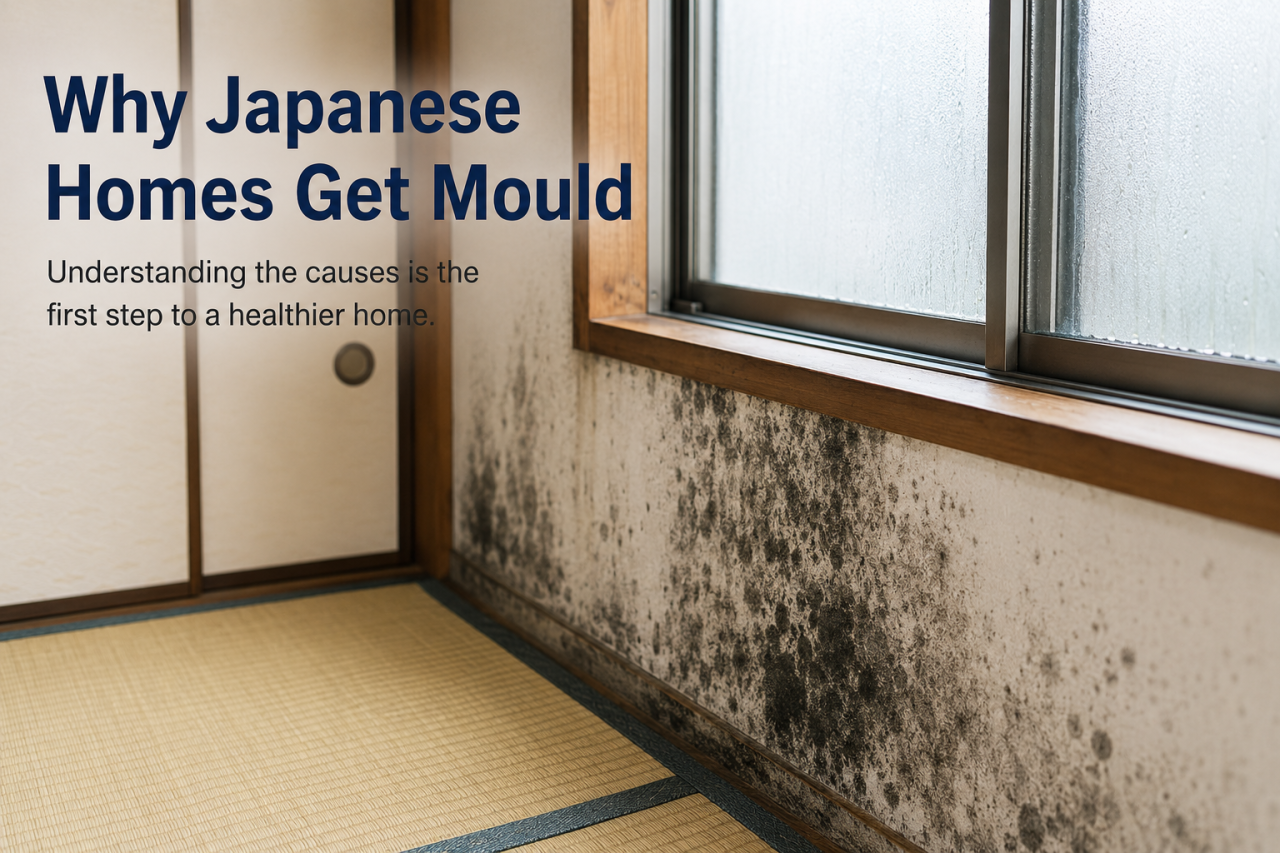
Why Japanese Homes Get Mould
Japan’s Climate, Condensation, Ventilation and Hidden Moisture Can Create Mould Problems Even in Well-Maintained Homes
If you live in Japan and have found mould around a window, inside a closet, behind furniture, on a tatami mat, or along an exterior wall, you may wonder why it keeps appearing.
The key point is simple:
Mould in Japanese homes is often not caused by poor cleaning alone.
In many cases, several conditions overlap. These can include Japan’s humid seasons, condensation caused by temperature differences, insufficient airflow, moisture trapped in building materials, and hidden moisture inside walls or other enclosed spaces.
Modern Japanese homes can also be highly airtight. This improves comfort and energy efficiency, but moisture generated inside the home may remain indoors when ventilation and airflow are not working effectively. Project materials used by MIST工法®カビバスターズ identify trapped humidity, condensation and insufficient ventilation as important factors when investigating recurring mould.
Japan’s Climate Creates Long Periods of Moisture Exposure
People arriving from countries with drier climates are sometimes surprised by how quickly a home in Japan can feel damp.
Japan has periods when warm, moisture-rich outdoor air enters buildings. Everyday activities such as bathing, cooking and drying laundry indoors can add even more moisture.
The important issue is not simply that moisture exists.
The problem begins when that moisture cannot escape.
A room may appear clean and dry in the centre while moisture remains around colder walls, behind wardrobes, inside closets or in other places where air barely moves.
This is one reason mould can appear in a Japanese home even when the resident cleans regularly.
Condensation Can Occur on More Than Just Windows
Many residents first notice condensation as water droplets on a window.
However, condensation can also occur on colder building surfaces.
When warm, humid air reaches a sufficiently cold surface, moisture in the air can turn into water. If this repeatedly occurs around walls, ceilings, window frames or concealed building components, those areas can remain damp.
For example, an air-conditioned room in summer may be cool while the outdoor air is warm and humid. Depending on the building structure and airflow, this temperature difference can contribute to condensation in places that are not immediately visible.
That means the visible mould may be only the result, while the actual moisture problem is somewhere else.
Closets, Furniture and Tatami Can Restrict Airflow
Japanese homes often contain spaces where air movement is limited.
Closets, storage areas, the backs of large wardrobes, beds positioned close to walls and enclosed spaces can all create pockets of still air.
When moist air remains in these areas and a nearby surface is cool, the conditions become more favourable for mould development.
The same principle applies to belongings stored tightly against a wall.
Imagine placing a wet towel inside a closed plastic bag. Even if the room outside the bag is comfortable, moisture stays trapped inside.
A poorly ventilated space behind furniture can behave in a similar way.
This is why simply opening a window occasionally may not solve a mould problem occurring deep inside a closet or behind fixed furniture.
Ventilation Does Not Always Mean the Building Is Ventilating Properly
Many modern homes in Japan have mechanical ventilation systems.
However, the presence of a ventilation fan does not automatically mean that every room has balanced airflow.
Blocked air inlets, dirty filters, closed vents, changes made during renovation, strong exhaust fans or differences between supply and exhaust airflow can affect how air moves through a building.
In some properties, excessive negative pressure may also influence the direction in which air and moisture move through gaps in the building.
For this reason, MIST工法®カビバスターズ can use airflow measuring equipment to examine ventilation volume and pressure conditions during a detailed investigation. Project materials also identify the measurement of supply and exhaust airflow and indoor pressure differences as useful ways to evaluate ventilation balance.
The Moisture Source May Be Hidden Inside the Building
One of the most difficult situations is when mould repeatedly returns after the wall has been cleaned.
In such cases, looking only at the visible surface may not be enough.
Moisture can sometimes remain inside wall materials, behind finishes or in other concealed parts of the building.
MIST工法®カビバスターズ therefore considers the condition of the building itself during an investigation.
Depending on the property, we may measure the moisture content of building materials to determine whether areas that appear dry on the surface are retaining moisture.
We may also use a fibre scope to inspect areas inside walls where visual inspection from the room is not possible.
These investigations help answer a much more useful question than simply:
“Where is the mould?”
The better question is:
“Why is this part of the building staying damp?”
Cleaning the Surface Without Finding the Cause Can Lead to Recurrence
If mould appears because of condensation, hidden moisture or ventilation imbalance, cleaning the surface does not automatically change those conditions.
The wall may look clean again, but the same moisture cycle may continue.
This is why MIST工法®カビバスターズ places importance on the sequence of:
inspection → identification of the cause → appropriate mould treatment → improvement of the underlying conditions.
Project materials also emphasise that insufficient investigation of the cause can leave the conditions that allowed mould to develop in the first place.
When the cause is unclear, professional fungal testing can also be considered.
Through cooperation with the General Incorporated Association for Microbial Control(一般社団法人微生物対策協会), fungal testing can help evaluate mould conditions that cannot be understood through visual inspection alone.
This can be particularly useful when:
mould repeatedly returns after cleaning,
there is a persistent musty smell,
mould is visible in several parts of the property,
moisture may be hidden inside the building, or
the tenant, landlord or property manager needs clearer information about the condition of the property.
Start by Finding the Cause, Not Just Removing the Stain
If mould keeps appearing in your apartment or house in Japan, repeatedly wiping the same area may not be the best starting point.
First determine whether the problem is related to condensation, ventilation, retained moisture or a concealed building condition.
MIST工法®カビバスターズ investigates mould problems throughout Japan and accepts enquiries from English-speaking residents, property owners, companies and property managers.
If you are dealing with a mould problem that is difficult to handle yourself, professional investigation can help clarify what is happening before further repair or cleaning is carried out.
English enquiries are welcome.
The first step in solving a recurring mould problem is not simply asking:
“How do I clean it?”
It is finding out:
“Why does mould keep growing here?”

Who Pays for Mould Damage in a Rental Home in Japan?
Landlord or Tenant? Understanding Mould Responsibility Under Japan’s Rental Restoration Guidelines
For foreign residents renting an apartment or house in Japan, one of the first questions after discovering mould is often:
“Who has to pay for this?”
The answer is not automatically “the tenant” or “the landlord.”
In Japan, responsibility for mould-related cleaning and repair depends on why the mould developed, how the property was used, whether the problem was reported, and what the rental agreement says.
The Ministry of Land, Infrastructure, Transport and Tourism(国土交通省)provides the Guidelines for Troubles Concerning Restoration to Original Condition, commonly referred to in Japanese as the Genjō Kaifuku Guideline(原状回復をめぐるトラブルとガイドライン).
These guidelines are an important starting point when discussing responsibility between landlords and tenants.
However, a mould stain alone does not tell you who is responsible.
The cause must be investigated first.
Normal Ageing and Tenant-Caused Damage Are Treated Differently
Japan’s restoration guidelines distinguish between deterioration associated with ordinary use and ageing, and damage caused by the tenant’s negligence or failure to take reasonable care of the property.
This distinction is especially important with mould.
For example, if a building develops condensation because of its structure, insulation, water intrusion or another property-related condition, simply finding mould does not automatically prove that the tenant caused it.
On the other hand, the Ministry’s guidelines specifically give an example involving mould and stains that became worse because condensation was left unattended.
The guidance explains that where a tenant fails to notify the landlord and does not take reasonable steps such as wiping away condensation, resulting deterioration may be considered the tenant’s responsibility.
In other words:
The important question is not simply “Is there mould?”
It is:
“What caused the moisture, and what happened after the problem became noticeable?”
When Might the Tenant Be Responsible?
A tenant may potentially be asked to bear some responsibility when the way the property was used contributed significantly to the damage.
The Ministry’s Q&A explains that failing to carry out ordinary cleaning, allowing condensation to remain unattended, or otherwise failing to take reasonable care may lead to tenant responsibility when this causes additional deterioration.
For mould problems, factors that may therefore need to be reviewed include whether visible condensation was repeatedly left untreated, whether mould was allowed to spread without being reported, and whether reasonable ventilation or routine care was carried out.
However, these points should not be judged in isolation.
A room may have been ventilated normally and still develop mould because of a hidden moisture problem inside the building.
That is why it can be risky to decide responsibility only from photographs of the mould.
When Might the Building or Landlord Side Need to Be Investigated?
Mould can also be connected to conditions that residents cannot easily control.
Possible issues may include water entering the building, moisture retained inside construction materials, condensation caused by building conditions, insufficient ventilation performance, hidden dampness inside walls, or an imbalance in the movement of air through the property.
In these situations, telling the tenant simply to “ventilate more” may not address the actual cause.
For example, imagine repeatedly finding water on the floor below a sink.
You could wipe the floor every day, but if a pipe hidden inside the cabinet is leaking, wiping the floor will never solve the real problem.
Recurring mould can work in much the same way.
If the moisture source is inside the building, the visible mould may only be the place where the problem becomes noticeable.
This is why cause investigation should come before deciding who should pay.
Why Objective Investigation Matters in a Mould Dispute
When a tenant says,
“This is a building problem.”
and the landlord or property manager says,
“This happened because of the way the tenant lived.”
the situation can quickly become difficult.
Arguments based only on impressions rarely clarify the cause.
MIST工法®カビバスターズ therefore places importance on investigating the physical conditions of the property.
Depending on the situation, this may include checking three main areas.
1. Moisture Content of Building Materials
A wall can look dry while moisture remains inside the material.
Measuring the moisture content of building materials can help identify areas where abnormal moisture may be present.
This information can be useful when determining whether the mould is associated with a continuing moisture source rather than simple surface contamination.
2. Hidden Areas Inside Walls
If the suspected source cannot be seen from the room, a fibre-scope inspection may be used to examine concealed areas inside walls or other building spaces.
This can help investigate whether moisture, deterioration or conditions favourable to mould exist behind the visible surface.
3. Ventilation and Pressure Conditions
Ventilation problems are not always obvious.
MIST工法®カビバスターズ can use airflow measuring equipment to examine ventilation conditions and negative pressure within the property.
If supply and exhaust airflow are unbalanced, air may travel through unintended routes in the building.
Understanding this airflow can be an important part of determining why certain walls, closets or rooms repeatedly develop mould.
Fungal Testing Can Add Another Layer of Evidence
Visual inspection tells us where mould can be seen.
It does not necessarily tell us what is happening throughout the indoor environment.
For properties where the extent of contamination is unclear, fungal testing should also be considered.
MIST工法®カビバスターズ works in cooperation with the General Incorporated Association for Microbial Control(一般社団法人微生物対策協会).
Fungal testing can help provide objective information about mould conditions and can be particularly useful when there is a persistent mould smell, mould keeps returning after cleaning, several rooms are affected, or the visible condition does not explain the seriousness of the problem.
For tenants, landlords and property managers, having objective inspection information can also make discussions more constructive.
Instead of arguing only about who is responsible, the parties can begin by asking:
Where is the moisture coming from?
Report Mould Problems Early
If you are renting a property in Japan and discover serious condensation, water intrusion, unusual dampness or recurring mould, do not simply ignore it until you move out.
Document what you find.
Photographs showing the date and location can be useful.
You should also contact the landlord or property management company promptly and keep a record of the communication.
The Ministry’s guidance specifically addresses situations where condensation is left unattended and the landlord is not notified, so early communication can be important when the cause and responsibility are later discussed.
The Ministry of Land, Infrastructure, Transport and Tourism also provides multilingual information for foreign residents about restoration to original condition.
Do Not Decide Who Pays Before You Know Why the Mould Appeared
When mould appears in a rented home in Japan, there are two separate questions:
What caused the mould?
and
Who is responsible for the resulting costs?
The second question should not be answered before the first one has been properly considered.
If cleaning alone has not solved the problem, or if the tenant and property manager disagree about the cause, a professional investigation can provide useful information before repair work begins.
MIST工法®カビバスターズ supports mould investigations throughout Japan.
We investigate visible mould as well as the conditions behind it, including moisture in building materials, concealed wall spaces, airflow and ventilation conditions. Fungal testing can also be considered in cooperation with the General Incorporated Association for Microbial Control.
English-language enquiries are welcome.
If you are unsure whether the mould in your Japanese rental home is primarily related to daily use or to the building itself, start by investigating the cause.
Find the cause first. Then discuss responsibility.

Where to Get Help in English for Mould Problems in Japan
English-Speaking Support for Tenants, Homeowners, Property Managers and Companies Across Japan
Finding mould in your home is stressful enough.
Trying to explain the problem in another language can make the situation much more difficult.
Foreign residents in Japan may need to communicate with a landlord, property management company, relocation company, employer, repair contractor and mould specialist at the same time.
The problem becomes even more complicated when technical terms such as condensation, moisture content, ventilation imbalance or hidden mould are involved.
For this reason, MIST工法®カビバスターズ accepts enquiries from English-speaking residents and organisations dealing with mould problems in Japan.
We provide support for mould-related problems throughout Japan.
Whether you live in a rented apartment, detached house, company housing or another type of property, the first goal is to understand what is happening inside the building and why the mould is developing.
You Do Not Need to Know the Cause Before Contacting Us
Many people hesitate to contact a specialist because they cannot explain exactly what is wrong.
That is not necessary.
You may only know that:
mould keeps appearing on the same wall,
there is a strong musty smell,
condensation forms frequently,
mould is growing inside a closet,
wallpaper is becoming discoloured,
the room feels unusually damp,
the landlord and tenant disagree about the cause, or
cleaning the mould has not stopped it from returning.
These observations are already useful starting points.
You do not need to diagnose the building yourself.
Our role is to investigate the conditions and help organise the information needed to understand the problem.
What Information Should You Send With Your Enquiry?
When contacting MIST工法®カビバスターズ, providing some basic information can help us understand the situation more efficiently.
If possible, tell us:
Where the property is located
The prefecture and city are useful because MIST工法®カビバスターズ responds to mould problems nationwide in Japan.
What type of property it is
For example:
apartment, condominium, detached house, company housing, dormitory or other accommodation.
Where the mould is appearing
Such as:
walls, ceiling, windows, closet, tatami, behind furniture, bathroom, air-conditioning area or storage space.
When you first noticed the problem
It is also helpful to explain whether the problem is seasonal or continues throughout the year.
Whether the mould returns after cleaning
Recurring mould can indicate that the moisture conditions supporting its growth may still be present.
Whether there is a musty smell
A mould-like odour can sometimes be noticed even when the main affected area is not immediately visible.
Whether there has been condensation, a leak or water damage
Any history of moisture problems can be important when investigating the cause.
Photographs can also help communicate the visible condition of the property.
However, photographs alone may not reveal what is happening behind the surface.
A Professional Mould Investigation Looks Beyond What You Can See
One of the most important differences between simple mould cleaning and professional investigation is that the investigation does not stop at the visible stain.
MIST工法®カビバスターズ considers the relationship between mould, moisture and the building environment.
Depending on the situation, several types of investigation may be considered.
Fungal Testing
When there is concern about the extent of mould contamination, fungal testing can provide additional information that cannot be obtained through visual inspection alone.
MIST工法®カビバスターズ works in cooperation with the General Incorporated Association for Microbial Control(一般社団法人微生物対策協会).
If you are worried about recurring mould, unexplained musty odours or conditions that cannot be evaluated by sight alone, fungal testing should be considered as part of the investigation.
Moisture Content Testing
Visible mould often appears where moisture has remained for a period of time.
However, the surface of a wall may feel dry even when moisture remains within the building material.
MIST工法®カビバスターズ can measure the moisture content of indoor building materials.
This helps us investigate whether excess moisture may be contributing to the mould problem.
Fibre-Scope Inspection
The visible side of a wall does not show what is happening inside it.
Where appropriate, we use a fibre scope to inspect concealed spaces inside walls and other areas that cannot normally be seen.
This can be especially important when mould continues to return in the same location or when there is reason to suspect hidden moisture.
Airflow and Negative Pressure Checks
Mould problems can also be connected to how air moves through a building.
Simply having a ventilation fan does not guarantee that ventilation is working as intended.
MIST工法®カビバスターズ uses airflow measuring equipment when necessary to examine ventilation conditions and negative pressure within the building.
These checks can provide information about whether air is moving through unintended routes or whether ventilation balance may be contributing to moisture accumulation.
Why Finding the Cause Matters in Modern Buildings
A modern building is a connected system.
Insulation, airtightness, air conditioning, ventilation, exterior temperature and indoor moisture all affect one another.
Changing one condition can influence another part of the building.
This is why recurring mould should not always be treated as an isolated stain on a wall.
Imagine seeing water repeatedly collecting under a refrigerator.
Wiping the floor makes the water disappear temporarily.
But if the source is a hidden leak, the floor will become wet again.
Mould can behave in a similar way.
Cleaning removes what you can see.
Investigation helps determine why it appeared.
If condensation, retained moisture, hidden water intrusion or ventilation problems remain unchanged, the conditions that allowed mould to develop may also remain.
For this reason, MIST工法® focuses on identifying the cause and considering improvements to the underlying environment rather than looking only at the visible surface.
English Support Can Also Help Property Managers and Companies
Our English-language support is not limited to individual residents.
Mould problems in Japan may involve several parties, particularly in accommodation provided to foreign employees or international residents.
Enquiries may come from:
Foreign residents
who have discovered mould in their apartment or house.
Landlords and property owners
who need to understand why mould is occurring in a property occupied by an international tenant.
Property management companies
that need technical information about recurring mould problems.
Relocation companies
supporting expatriates and their families in Japan.
Corporate General Affairs or HR departments
managing company housing or accommodation for foreign employees.
In these situations, clear communication about the physical condition of the property is important.
The objective should be to move the discussion away from assumptions and toward evidence about moisture, airflow, concealed areas and mould conditions.
What Happens After You Contact Us?
The first stage is to organise the information about the property and the mould problem.
From there, we consider what type of investigation may be appropriate.
The exact approach depends on the building and the condition of the affected area.
The important point is that the investigation begins with the cause.
A typical way of thinking about the problem is:
Visible mould
→ moisture investigation
→ hidden-area investigation
→ ventilation and airflow assessment
→ fungal testing when necessary
→ identification of likely contributing conditions
→ consideration of appropriate measures
This approach helps avoid treating every mould problem in exactly the same way.
Mould Problems Can Be Easier to Discuss When the Cause Is Visible
Language differences can make a mould problem feel more complicated than it actually is.
But the building itself provides evidence.
Moisture can be measured.
Hidden areas can be inspected.
Airflow can be checked.
Fungal conditions can be investigated.
By gathering this information, conversations between residents, landlords and property managers can become more focused on the actual condition of the property.
Instead of arguing:
“Whose fault is the mould?”
a more productive starting point is:
“What conditions are causing the mould?”
Once the cause becomes clearer, the next steps can also become easier to organise.
Contact MIST工法®カビバスターズ for Mould Problems in Japan
If you are living in Japan and struggling with mould that keeps returning, a strong musty smell or unexplained dampness, you do not have to determine the cause by yourself.
MIST工法®カビバスターズ provides mould investigation support across Japan and accepts English-language enquiries.
We can consider fungal testing in cooperation with the General Incorporated Association for Microbial Control, measure moisture in building materials, investigate concealed areas using a fibre scope, and examine airflow and negative pressure where necessary.
If a mould problem has become too difficult to manage with normal cleaning, the next step should not simply be stronger cleaning.
Start by finding out why the mould is growing.
For mould problems in Japanese homes, apartments and company housing:
English enquiries are welcome.
Nationwide support is available in Japan.
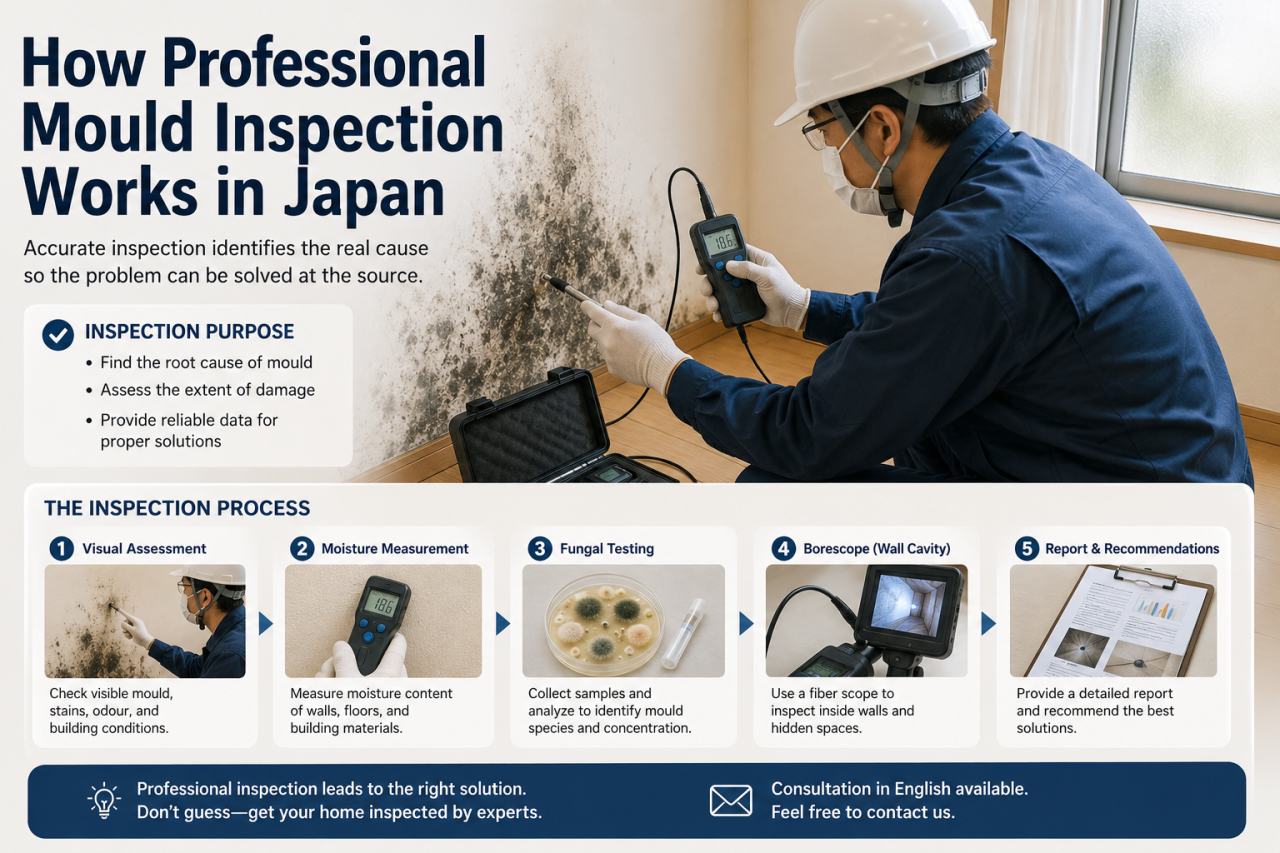
How Professional Mould Inspection Works in Japan
Fungal Testing, Moisture Measurement, Fibre-Scope Inspection and Airflow Checks Help Identify Why Mould Keeps Returning
If mould keeps coming back after cleaning, the next step should not be to use a stronger cleaner.
The more important step is to find out why the affected area continues to provide conditions in which mould can develop.
A professional mould inspection looks beyond the visible black, green or white marks on the surface.
At MIST工法®カビバスターズ, we investigate the relationship between mould, moisture, airflow and the building itself.
Depending on the property, an investigation may include:
fungal testing,
moisture content measurement,
fibre-scope inspection,
airflow and ventilation measurement,
negative-pressure checks, and
inspection of the building environment.
These methods are useful because recurring mould may be connected to several different causes at the same time. Project materials used by MIST工法®カビバスターズ identify ventilation balance, moisture retained in building materials, concealed wall conditions and fungal testing as key parts of investigating recurring mould.
Why Visual Inspection Alone May Not Be Enough
Imagine seeing a dark mould stain in the corner of a bedroom.
You can see where the mould appeared.
But that does not automatically tell you why it appeared there.
The source may be condensation on a cold wall.
It may be moisture retained inside the wall.
It may be a ventilation imbalance.
It may be water entering from another part of the building.
Or humid air may be moving into a concealed space because of pressure differences within the property.
This is why professional mould investigation should not begin with the assumption that every mould problem has the same cause.
A visible stain is evidence that a problem exists.
It is not necessarily evidence of where the problem started.
1. Fungal Testing: Understanding Mould Beyond What You Can See
The first investigation to consider when the mould condition is unclear is fungal testing.
MIST工法®カビバスターズ works in cooperation with the General Incorporated Association for Microbial Control(一般社団法人微生物対策協会).
Fungal testing can provide information that cannot be obtained simply by looking at the colour or size of a visible mould stain.
Depending on the purpose of the investigation, samples can help provide a more objective picture of the mould condition.
This may be particularly useful when:
mould repeatedly returns after cleaning,
there is a strong musty smell,
the main affected area cannot be located,
several rooms appear to be affected,
mould may be hidden behind finishes, or
more objective information is needed before deciding what action to take.
Visual inspection and fungal testing serve different purposes.
A photograph tells us:
“Mould can be seen here.”
Testing helps add another question:
“What is the actual fungal condition of this environment?”
This is one reason we recommend considering fungal testing when you are worried about a mould problem that cannot be explained by appearance alone. Project materials also position fungal testing as part of a wider investigation rather than relying solely on visible mould.
2. Moisture Content Testing: Is the Building Material Still Damp?
Mould requires suitable environmental conditions.
One of the most important factors to investigate is moisture.
The difficulty is that building materials do not always look wet when they are retaining moisture.
Wallpaper may feel dry.
A wooden surface may appear normal.
A wall may have no visible water droplets.
Yet moisture may still be present within the material.
MIST工法®カビバスターズ therefore performs moisture content measurements of building materials when appropriate.
This helps us investigate whether moisture is concentrated in the area where mould has appeared.
It may also help compare the affected area with surrounding locations.
The purpose is not simply to take a measurement.
The purpose is to understand the pattern.
For example:
Why is one part of the wall retaining more moisture than another?
Why does the same corner repeatedly develop mould?
Why is a closet damp even though the centre of the room feels comfortable?
These questions can provide clues about the source of the problem.
Project materials specifically identify moisture-content testing as a way to investigate moisture that cannot be recognised through visual inspection alone.
3. Fibre-Scope Inspection: Looking Inside the Wall
Some of the most important parts of a building cannot be seen from inside the room.
Behind a finished wall may be:
insulation, timber, pipes, cavities and other building components.
If moisture or condensation develops in these concealed areas, the resident may not notice anything until a smell, stain or mould appears on the room side.
This is where a fibre scope can be useful.
A fibre scope is a small camera used to inspect places that cannot normally be seen directly.
MIST工法®カビバスターズ uses fibre-scope inspection when it is necessary to check conditions inside walls and other concealed spaces.
This can help investigate questions such as:
Is there moisture behind the wall?
Is there visible deterioration inside the cavity?
Does the hidden area correspond with the mould seen inside the room?
This type of investigation is especially important when the mould repeatedly develops in the same area despite surface cleaning.
Project materials identify fibre-scope inspection as one of the core methods for checking concealed wall conditions and possible hidden moisture.
4. Airflow Measurement: Is the Ventilation System Actually Moving Air?
Many people assume that if a home has ventilation fans, the home must be properly ventilated.
Unfortunately, ventilation is not simply a question of whether a fan is switched on.
Air needs somewhere to enter.
Air needs somewhere to leave.
And the balance between supply and exhaust matters.
MIST工法®カビバスターズ can use an airflow meter to examine how air is moving through the property.
Possible inspection points can include:
supply-air inlets,
exhaust outlets,
ventilation fans,
kitchen exhaust systems,
24-hour ventilation systems, and
other points that influence airflow through the building.
The purpose is to understand whether the intended ventilation route is actually functioning.
Project materials describe airflow measurements as a way to examine supply and exhaust conditions and assess the overall ventilation balance.
5. Negative Pressure: A Hidden Factor in Some Modern Homes
Another factor that deserves attention is negative pressure.
Negative pressure means that the air pressure inside a room or building is lower than in an adjacent space or outdoors.
This can happen when exhaust airflow is stronger than the amount of replacement air entering the building.
Why does this matter for mould?
Because air follows pressure differences.
When indoor air is strongly exhausted, replacement air must enter from somewhere.
If the intended air inlets cannot supply enough air, outside air may be drawn through gaps and concealed parts of the building.
During warm and humid conditions, this movement of moisture-rich air may affect cold parts of the building envelope.
Depending on the building conditions, this can contribute to moisture accumulation or concealed condensation.
That is why simply telling residents to “use the ventilation fan more” is not always enough.
The balance of the ventilation system also matters.
Project materials used by MIST工法®カビバスターズ specifically identify negative pressure, ventilation balance and moisture movement into concealed wall areas as factors that should be investigated in some mould cases.
The Tests Work Best When They Are Combined
Each inspection method answers a different question.
Fungal testing
helps examine the mould condition.
Moisture measurement
helps investigate where moisture is being retained.
Fibre-scope inspection
helps reveal conditions inside concealed building spaces.
Airflow measurement
helps determine how ventilation is functioning.
Negative-pressure inspection
helps examine how pressure differences may be influencing air movement.
Using only one of these methods may provide part of the answer.
Combining them can create a clearer picture of how the mould, moisture and building conditions are connected.
This is why MIST工法®カビバスターズ places importance on cause investigation rather than surface appearance alone. The project’s inspection framework likewise combines fungal, moisture, concealed-space and airflow checks to identify the conditions behind recurring mould.
A Mould Problem Is Often a Building-Environment Problem
When people see mould, their first reaction is often:
“What product should I use to remove it?”
But when mould repeatedly returns, the better question becomes:
“What is continuing to make this location suitable for mould?”
For example, if the real problem is hidden condensation inside a wall, cleaning the wallpaper does not change the condensation.
If the problem is retained moisture, repainting the wall does not remove the moisture source.
If the problem is ventilation imbalance, opening a window occasionally may not correct the way air moves through the building.
The objective of professional investigation is therefore to connect three things:
Where the mould appears
→ where the moisture is coming from
→ why that moisture remains there
Once these relationships become clearer, it becomes easier to consider an appropriate response.
When Should You Consider a Professional Mould Inspection?
A specialist investigation should be considered when the problem cannot be reasonably explained through normal daily conditions.
In particular, professional inspection may be useful when mould returns after repeated cleaning, there is a persistent musty smell, several areas of the property are affected, condensation appears frequently, there has been a history of water intrusion, or you suspect the mould may extend behind walls or other finishes.
You should also consider an investigation when there is a disagreement between a tenant, landlord or property manager about what is causing the mould.
In these situations, measurements and inspection findings can provide more useful information than assumptions based only on photographs.
Find the Cause Before Repeating the Same Repair
Replacing wallpaper, repainting a wall or repeatedly cleaning the same area may improve its appearance.
But if the moisture conditions remain unchanged, the underlying reason for the mould may also remain.
That is why the order matters.
Find the mould.
Measure the moisture.
Check hidden areas.
Examine the airflow.
Investigate the cause.
Then decide what needs to change.
MIST工法®カビバスターズ provides professional mould investigation support throughout Japan.
Through fungal testing in cooperation with the General Incorporated Association for Microbial Control, moisture-content measurement, fibre-scope investigation and airflow or negative-pressure checks, we work to understand the cause behind recurring mould problems.
English-language enquiries are welcome.
If mould keeps returning in your Japanese apartment or home, do not judge the problem only by what is visible on the surface.
The real answer may be inside the building.
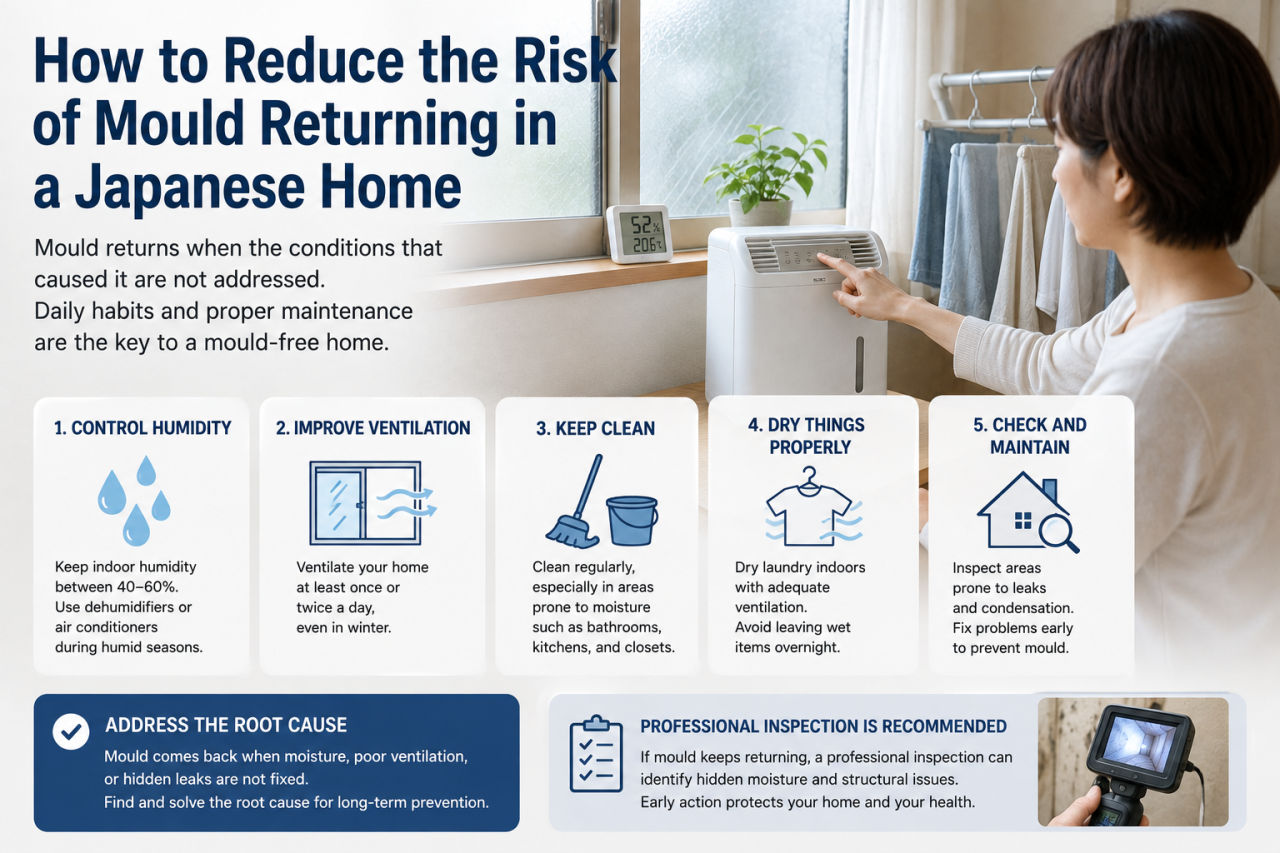
How to Reduce the Risk of Mould Returning in a Japanese Home
Cleaning Is Only the First Step: Moisture Control, Ventilation and Building Conditions Must Be Addressed Together
Removing visible mould can improve the appearance of a room.
However, if the conditions that allowed the mould to develop remain unchanged, the problem may return.
This is especially important in Japanese homes, where airtight construction, seasonal humidity, condensation, limited airflow and hidden moisture can overlap.
For this reason, effective mould prevention should not focus on cleaning alone.
The more important goal is to reduce the environmental conditions that support mould growth.
At MIST工法®カビバスターズ, we consider three areas particularly important:
moisture, airflow and the building itself.
Project materials also identify recurring moisture, poor ventilation, insulation or airtightness problems, and incomplete cause investigation as common factors behind repeated mould problems.
1. Control Moisture Before It Accumulates
The first priority is to understand where moisture is coming from.
Indoor moisture can come from everyday activities such as cooking, bathing and drying laundry.
But moisture can also enter or remain in a building because of condensation, water intrusion or moisture trapped within construction materials.
This distinction matters.
If the moisture is mainly generated by daily activities, changing how the room is ventilated or dehumidified may help.
If the moisture is coming from inside a wall or another concealed part of the building, changing everyday habits alone may not solve the problem.
That is why MIST工法® does not judge the cause simply by looking at the visible mould.
Moisture-content testing can help determine whether a building material is retaining moisture that cannot be identified by touch or appearance alone.
2. Keep Air Moving Through Closets and Behind Furniture
A room can feel comfortable while certain areas remain poorly ventilated.
Typical examples include:
closets, the back of wardrobes, corners of bedrooms, areas behind beds, enclosed storage spaces and walls covered by large pieces of furniture.
These spaces often receive less airflow than the centre of the room.
If humid air becomes trapped there, surfaces may remain damp for longer.
One simple prevention measure is therefore to avoid blocking airflow completely.
Where practical, leave some space between large furniture and exterior walls.
Do not overfill closets so tightly that air cannot circulate.
Open storage spaces periodically when conditions allow.
The objective is not simply to “air out the room.”
It is to reduce places where humid air can remain trapped.
3. Do Not Assume a Ventilation Fan Means Good Ventilation
Modern Japanese homes commonly use mechanical ventilation.
But ventilation only works properly when air can enter and leave the building through the intended routes.
A fan may be operating while airflow remains weak because an inlet is blocked, a filter is dirty or the overall supply-and-exhaust balance is poor.
For this reason, ventilation performance should sometimes be measured rather than assumed.
MIST工法®カビバスターズ can use airflow measuring equipment to investigate ventilation volume and pressure conditions.
This becomes particularly important when mould develops repeatedly in specific rooms despite normal use of the ventilation system.
In some buildings, negative pressure can also cause air to be drawn through unintended gaps and concealed spaces.
The problem is therefore not always “too little ventilation.”
Sometimes the real issue is how the air is moving.
4. Watch for Condensation in Places You Cannot Easily See
Most people recognise condensation when water appears on a window.
But condensation can also occur on walls, inside closets or within concealed parts of a building.
Project materials for modern housing highlight the combination of airtight construction, temperature differences and retained humidity as factors that can allow condensation and mould to recur.
Summer can be particularly confusing.
When indoor surfaces are cooled by air conditioning while warm, humid outdoor air enters or moves through parts of the building, moisture may collect on colder surfaces.
This can occur even when there is no obvious water on the window.
If mould repeatedly appears in one location, the important question is:
“Is this surface becoming colder or wetter than the surrounding area?”
A professional investigation can help answer that question.
5. Treat Recurring Mould as a Sign That the Cause May Still Be Present
If mould returns in the same place after cleaning, it is useful to think of recurrence as information.
It may indicate that moisture, airflow or another building condition has not yet been corrected.
Project materials identify several recurring patterns, including unresolved moisture, poor ventilation, insulation or airtightness issues, and insufficient investigation of the original cause.
Repeatedly cleaning the same wall without changing those conditions can become a cycle:
mould appears
→ surface is cleaned
→ appearance improves
→ moisture remains
→ mould appears again
Breaking this cycle requires attention to the cause.
6. Check Hidden Areas When the Visible Problem Does Not Make Sense
Sometimes the location of visible mould does not match the obvious source of moisture.
For example, there may be mould on an interior wall even though no leak or condensation can be seen in the room.
In these situations, concealed areas may need to be investigated.
MIST工法®カビバスターズ can use a fibre scope to inspect inside walls and other hidden spaces where necessary.
A moisture meter can also help identify differences in the moisture condition of building materials.
These tools are especially useful when:
mould keeps returning in the same area,
a strong musty smell remains,
the wall has unexplained staining,
or previous cleaning and repairs have not solved the problem.
The objective is to avoid guessing.
7. Consider Fungal Testing When the Extent of the Problem Is Unclear
Visible mould does not always show the full condition of the indoor environment.
If mould is suspected in hidden areas, if there is persistent odour, or if contamination appears in several places, fungal testing may help provide additional information.
MIST工法®カビバスターズ works in cooperation with the General Incorporated Association for Microbial Control(一般社団法人微生物対策協会).
Fungal testing can be combined with building investigation to better understand the relationship between the mould condition and the moisture environment.
Project materials also position fungal testing as a way to make invisible mould conditions easier to evaluate objectively.
Prevention Means Changing the Conditions, Not Just the Appearance
The aim of mould prevention is not to promise that mould will never appear again.
Buildings, weather conditions and how rooms are used all change over time.
A more realistic approach is to reduce the conditions that make recurrence more likely.
That means looking at:
where moisture enters or remains,
how air moves through the building, and
whether hidden parts of the structure are staying damp.
It is similar to dealing with a recurring puddle on the floor.
Drying the floor is necessary.
But if water keeps entering from somewhere else, drying alone does not solve the source of the problem.
Mould prevention works in the same way.
When Should You Ask a Specialist for Help?
Professional investigation should be considered when mould repeatedly returns despite normal cleaning and ventilation.
It is also useful when mould appears over a wide area, when there is a persistent musty smell, when walls or floors seem unusually damp, or when the suspected cause may be inside the building.
In these cases, continuing to experiment with surface cleaning may delay identification of the real problem.
MIST工法®カビバスターズ provides mould investigation support throughout Japan.
Depending on the property, we can consider:
fungal testing,
moisture-content measurement,
fibre-scope inspection,
airflow measurement, and
negative-pressure investigation.
These findings can then be used to consider what environmental or building improvements may reduce the risk of recurrence.
Prevent Mould by Understanding Why It Appears
If you live in Japan, some degree of humidity is part of the climate.
The goal is therefore not simply to fight humidity every day.
The goal is to understand where moisture is accumulating and why it is not escaping.
If mould keeps returning, the building may be giving you an important clue.
Do not look only at the stain.
Look at the conditions around it.
MIST工法®カビバスターズ supports mould problems throughout Japan and accepts English-language enquiries.
If normal cleaning is no longer enough, start with an investigation of the cause.
Finding the moisture source is one of the most important steps toward reducing the risk of mould returning.
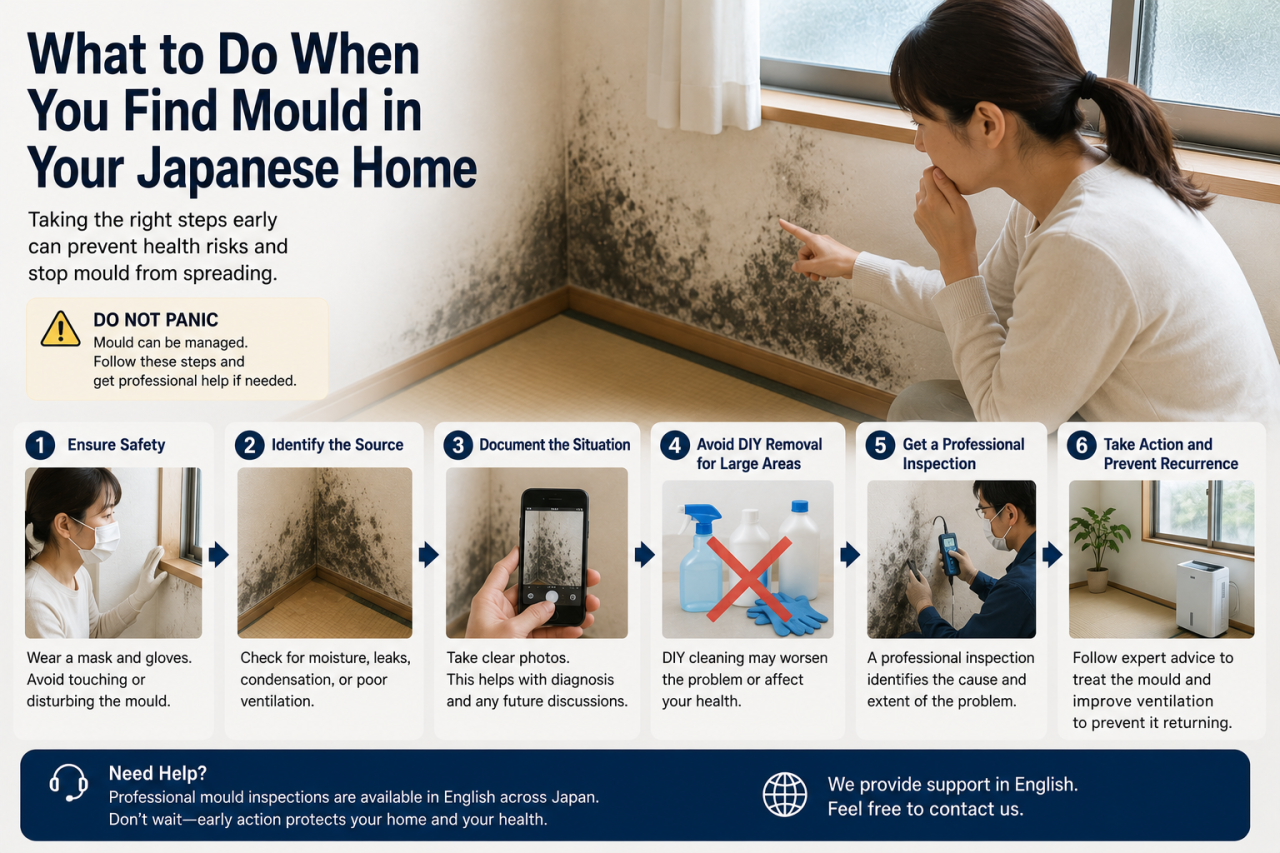
What to Do When You Find Mould in Your Japanese Home
A Practical First-Response Guide for Foreign Residents Before Cleaning, Repairing or Arguing About Responsibility
Finding mould in a Japanese apartment or house can lead to immediate questions.
Should you clean it yourself?
Should you contact the landlord first?
Should you stop using the room?
Should you replace the wallpaper?
And if you are renting, who will eventually pay?
The most important point is this:
Do not rush into cosmetic repair before documenting the condition and considering why the mould appeared.
Visible mould is the result of a moisture problem.
Before the evidence disappears, record what you can see and gather information about condensation, leaks, odours, ventilation and previous recurrence.
A sensible first response can make the later investigation much easier.
Step 1. Record the Condition Before Cleaning
Before wiping, painting or replacing anything, take photographs of the affected area.
Try to capture both close-up images and wider photographs showing where the mould is located within the room.
Useful details include:
the wall, ceiling or floor where mould is visible,
nearby windows or exterior walls,
furniture positioned close to the affected area,
condensation or visible moisture,
staining or damaged finishes,
mould inside closets or storage areas, and
any other affected rooms.
It is also useful to record approximately when you first noticed the problem and whether it has become worse over time.
If mould has returned after previous cleaning, keep that information as well.
For a professional investigation, the history of the problem can be almost as important as the condition on the day of inspection.
Step 2. Check for Obvious Sources of Moisture
Next, look around the affected area without dismantling the building yourself.
Check for signs such as:
water around windows,
repeated condensation,
damp wallpaper,
water stains,
a leaking air conditioner,
plumbing problems,
water around bathrooms or kitchens,
and unusual dampness near ceilings or exterior walls.
However, do not assume that the absence of visible water means there is no moisture problem.
Moisture can remain within building materials or concealed spaces even when the room surface appears dry.
This is one reason recurring mould requires more than a visual check.
Step 3. Do Not Cover the Problem With New Wallpaper or Paint Too Early
When mould appears on a wall, replacing wallpaper can seem like the fastest solution.
It may improve the appearance.
But if the wall is still retaining moisture, the underlying condition has not necessarily changed.
The same applies to repainting.
A new finish can hide the visible evidence without identifying the reason the area became damp.
Before cosmetic repair, it is better to ask:
Why did mould develop on this particular wall?
Was it condensation?
Was moisture entering from somewhere else?
Is the wall material retaining moisture?
Is the affected area poorly ventilated?
Could the problem extend behind the finish?
These questions should be considered before repeatedly repairing the surface.
Step 4. If You Rent, Inform the Landlord or Property Manager Early
If you live in a rental property, early communication is important.
Contact the landlord or management company when you notice significant condensation, water intrusion, unusual dampness or recurring mould.
Explain:
where the mould is,
when you noticed it,
whether it is recurring,
whether there is visible condensation or water,
and whether there is a persistent musty smell.
Provide photographs where appropriate.
Avoid beginning the conversation by deciding who is at fault.
A more useful starting point is:
“We have found recurring mould and would like the cause to be investigated.”
Responsibility for costs should be considered separately after the circumstances and cause have been reviewed.
Step 5. Avoid Guessing Whether the Cause Is the Tenant or the Building
One of the biggest problems in mould disputes is deciding responsibility before understanding the building condition.
A tenant may be told:
“You did not ventilate enough.”
A tenant may respond:
“The building has a defect.”
Without investigation, both statements may be assumptions.
Recurring mould can involve several overlapping factors.
These may include indoor moisture, condensation, furniture placement, ventilation conditions, retained moisture in building materials, water intrusion or conditions inside concealed wall spaces.
The objective should therefore be to separate what can be observed from what still needs to be investigated.
This becomes especially important in company housing or properties occupied by foreign residents, where the tenant, employer, relocation company, landlord and property manager may all be involved.
Step 6. Consider Fungal Testing When the Situation Is Unclear
Sometimes there is visible mould.
Sometimes there is mainly a musty smell.
And sometimes residents suspect mould because the same problem continues to appear in several parts of the property.
In these situations, fungal testing can be considered.
MIST工法®カビバスターズ works in cooperation with the General Incorporated Association for Microbial Control(一般社団法人微生物対策協会).
Fungal testing can provide information that visual observation alone cannot provide.
This can be particularly valuable when the affected area is difficult to identify or when an objective assessment of the mould condition is needed.
The purpose is not simply to confirm that a black stain looks like mould.
The aim is to better understand the condition of the indoor environment and use that information together with the building investigation.
Step 7. Check Whether Building Materials Are Holding Moisture
When mould repeatedly develops on the same wall, ceiling or floor, moisture measurement can provide important clues.
MIST工法®カビバスターズ can inspect the moisture content of indoor building materials.
The important point is not just whether a wall looks wet.
It is whether the material itself is retaining moisture.
If one area has a different moisture condition from surrounding areas, that difference may help guide further investigation.
For example, it may lead to questions about:
condensation,
water intrusion,
hidden plumbing,
construction conditions,
or moisture movement within the building.
This allows the investigation to move from:
“There is mould on this wall.”
to:
“Why is this wall behaving differently?”
Step 8. Investigate Behind the Surface When Necessary
If visible observations do not explain the mould, concealed areas may need to be checked.
MIST工法®カビバスターズ uses a fibre scope when appropriate to investigate conditions inside walls and other locations that cannot normally be seen.
This becomes particularly useful when:
mould repeatedly appears in the same location,
there is an unexplained musty smell,
the wall finish has been replaced before,
or moisture measurements suggest something unusual behind the surface.
Instead of removing large sections of the wall simply to see what is happening, a fibre-scope investigation can provide useful information about concealed conditions.
Step 9. Check Ventilation and Negative Pressure
Another important question is whether the building is moving air as intended.
Turning on a ventilation fan does not automatically prove that sufficient replacement air is entering the property.
MIST工法®カビバスターズ can use airflow measuring equipment to investigate ventilation conditions.
Where appropriate, we also examine negative pressure.
If exhaust is strong while incoming air is restricted, air may be pulled through unexpected parts of the building.
Depending on the structure and weather conditions, this movement of humid air can influence moisture conditions in concealed areas.
This is why recurring mould sometimes requires an investigation of the whole airflow system rather than simply checking the affected wall.
Step 10. Decide on Cleaning and Repair After the Cause Becomes Clearer
The ideal sequence is not:
Find mould → clean it → replace the wallpaper → wait and see.
A better sequence is:
Find mould
→ document the condition
→ identify moisture clues
→ investigate the building
→ check hidden areas where necessary
→ assess ventilation and airflow
→ consider fungal testing
→ clarify contributing causes
→ decide on appropriate cleaning, repair and prevention measures
This sequence reduces the risk of repeatedly treating only the appearance of the problem.
When DIY Cleaning May No Longer Be Enough
Small surface contamination and widespread recurring mould are not the same situation.
Professional investigation should be considered when the mould:
keeps returning,
extends across several locations,
is accompanied by a persistent musty smell,
appears together with unexplained moisture,
may be located behind walls or finishes,
or has already led to disagreement between the people responsible for the property.
In these situations, stronger cleaning products do not necessarily provide better answers.
The next question should be:
“What is creating the conditions for this mould?”
English Support Is Available Across Japan
Foreign residents do not need to understand Japanese building terminology before asking for help.
If you can explain where the mould is, what you have noticed and whether it keeps returning, that is enough to begin organising the problem.
MIST工法®カビバスターズ accepts English-language enquiries and supports mould problems throughout Japan.
Our investigation can consider fungal conditions in cooperation with the General Incorporated Association for Microbial Control, moisture within building materials, concealed spaces using a fibre scope, and ventilation or negative-pressure conditions using airflow measuring equipment.
If you are dealing with a mould problem that normal cleaning cannot resolve, avoid repeatedly covering the symptoms.
Document it.
Investigate the moisture.
Find the cause.
Then decide what needs to be changed.
That is a more reliable starting point for dealing with recurring mould in a Japanese home.
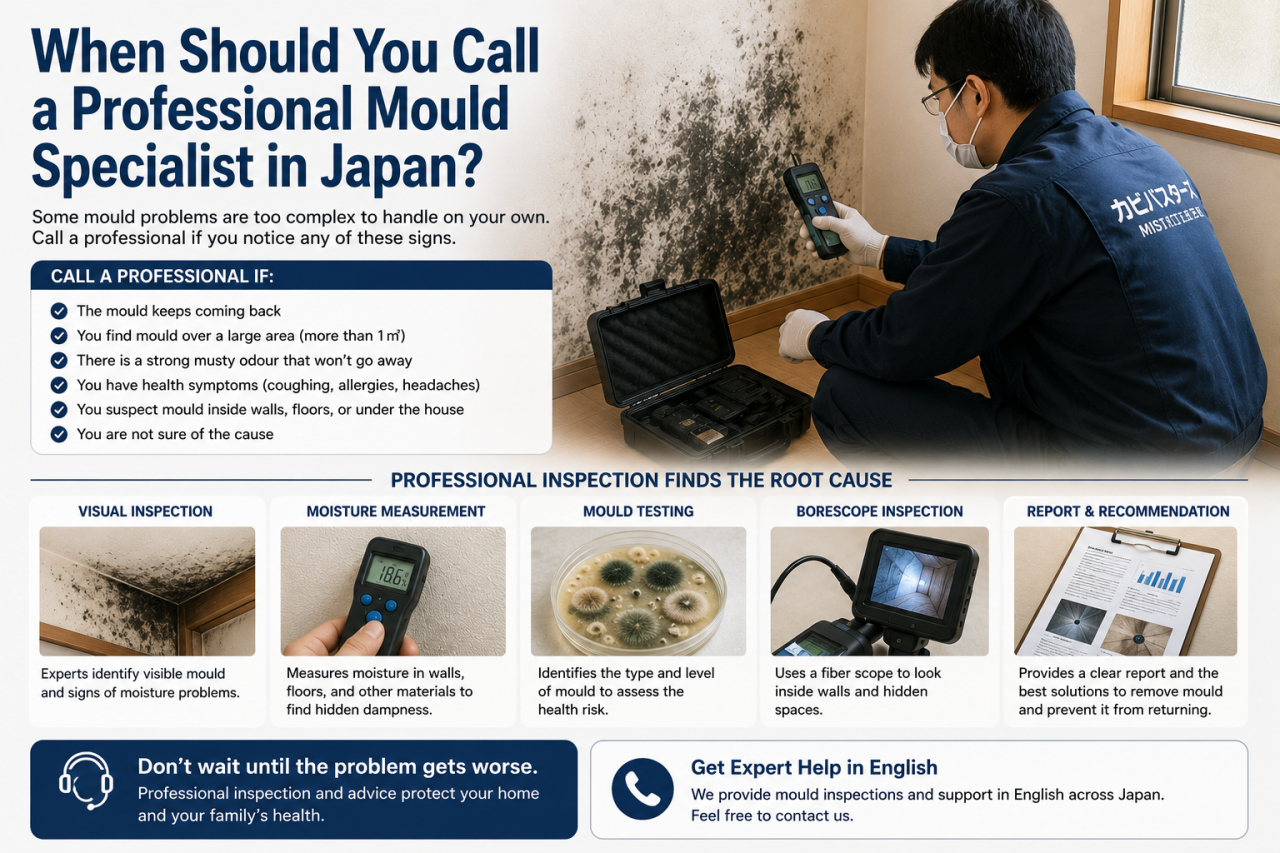
When Should You Call a Professional Mould Specialist in Japan?
Recurring Mould, Hidden Moisture and Unexplained Odours Are Signs That Surface Cleaning May Not Be Enough
Not every small mould spot requires a full professional investigation.
But when mould keeps returning, spreads to several areas, produces a persistent musty smell, or appears together with unexplained moisture, it may no longer be only a surface-cleaning issue.
The key question is not simply:
“How large is the mould?”
A better question is:
“Do we understand why it is growing?”
If the answer is no, professional investigation may be the next appropriate step.
At MIST工法®カビバスターズ, we investigate mould problems throughout Japan and accept enquiries in English.
Mould Keeps Returning After Cleaning
One of the clearest reasons to consider professional help is recurrence.
You clean the wall.
The stain disappears.
Several weeks or months later, mould develops in the same place again.
This pattern suggests that the conditions supporting the mould may still be present.
Possible factors include:
repeated condensation,
moisture retained in building materials,
limited airflow,
ventilation imbalance,
concealed moisture, or
water entering from another part of the building.
Cleaning may remove visible contamination.
It does not automatically remove the moisture source.
If the same location repeatedly develops mould, investigating the building environment can be more useful than repeatedly changing cleaning products.
There Is a Musty Smell but Little Visible Mould
A persistent musty smell deserves attention even when you cannot see a large amount of mould.
The source may be inside:
closets,
wall cavities,
under flooring,
behind furniture,
above ceilings,
or other concealed spaces.
Odour alone cannot identify exactly where mould is located.
However, when the smell continues despite cleaning and ventilation, further investigation may be appropriate.
Depending on the property, fungal testing can also be considered to add objective information about the indoor mould condition.
MIST工法®カビバスターズ works with the General Incorporated Association for Microbial Control(一般社団法人微生物対策協会) when fungal assessment is needed.
Mould Appears in More Than One Room
Mould in one small corner may be associated with a local condition.
Mould appearing in several rooms can require a wider view of the property.
For example, if mould is developing in bedrooms, closets and storage areas at the same time, the issue may involve more than one isolated surface.
Questions to investigate may include:
Is moisture building up throughout the property?
Is mechanical ventilation operating as intended?
Are certain exterior walls becoming unusually cold?
Is air moving properly between rooms?
Is there a common hidden moisture source?
A building-wide pattern should be investigated as a building-wide problem rather than as several unrelated stains.
You Can See Water Stains or Unexplained Dampness
Mould combined with water stains, damp finishes or unexplained moisture should not be treated as a cosmetic problem alone.
The visible mould may be secondary to another issue.
Depending on the property, the source could involve:
condensation,
water intrusion,
plumbing,
moisture retained within materials,
or another concealed condition.
MIST工法®カビバスターズ can measure the moisture content of building materials to investigate whether an affected area is retaining abnormal moisture.
Where necessary, a fibre scope can also be used to examine concealed spaces inside walls.
These checks can help move the investigation from:
“The wall looks mouldy.”
to:
“What is making this wall remain damp?”
The Wall Has Been Repaired but the Mould Came Back
Another important warning sign is repeated cosmetic repair.
Wallpaper is replaced.
The wall is repainted.
The room looks clean.
Then the mould returns.
When this happens, the problem may not have been the wallpaper itself.
The wall finish may simply be the place where an underlying moisture condition becomes visible.
Before repeating the same repair, it is worth investigating:
moisture levels,
concealed wall conditions,
condensation,
insulation-related temperature differences, and
ventilation performance.
Repeated repair without identifying the cause can create an expensive cycle.
The appearance changes.
The building condition does not.
Ventilation Is Running but the Problem Continues
Many residents understandably assume that operating a ventilation fan should prevent mould.
But a fan operating does not prove that the building has balanced ventilation.
Supply air must enter.
Exhaust air must leave.
The route between them must function properly.
If incoming air is restricted while exhaust remains strong, pressure conditions within the building can change.
MIST工法®カビバスターズ can use airflow measuring equipment to investigate ventilation conditions and negative pressure where appropriate.
This helps us examine whether air is moving as intended or whether moisture-rich air may be entering through unintended routes.
If mould continues despite regular use of the ventilation system, measurement can be more useful than simply assuming the fan is working correctly.
The Tenant and Landlord Disagree About the Cause
Professional investigation can also be useful when there is disagreement.
A tenant may believe the mould is caused by the building.
A landlord may believe it is caused by the resident’s lifestyle.
The mould itself does not automatically prove either position.
The most productive next step is often to gather objective information about the property.
This may include:
moisture measurements,
inspection of concealed areas,
ventilation and pressure assessment,
photographic documentation,
and fungal testing where appropriate.
These findings may help the parties discuss the physical condition of the property more clearly.
Responsibility for costs should be considered separately in light of the tenancy agreement, the circumstances and relevant Japanese guidance.
Company Housing and Expatriate Accommodation Can Require Faster Coordination
Mould problems can become particularly complicated in company housing or accommodation arranged for foreign employees.
The people involved may include:
the resident,
the employer,
a General Affairs or HR department,
a relocation company,
the property manager,
the landlord,
and contractors.
When several organisations are involved, unclear information can slow down decision-making.
A structured mould investigation can help everyone work from the same basic information.
Instead of asking each party to guess the cause, the discussion can focus on:
Where is the moisture?
How is air moving?
What is happening inside the building?
What mould condition can be confirmed?
This approach can make communication more efficient, especially when English and Japanese are both being used.
When Fungal Testing Should Be Considered
Fungal testing may be particularly useful when the extent of the mould problem is difficult to judge visually.
Consider discussing testing when:
there is recurring mould,
a musty smell continues without an obvious source,
several areas are affected,
hidden contamination is suspected, or
more objective information is needed before deciding on the next step.
Testing should not be treated as a replacement for investigating the building.
The strongest approach is often to combine information about the fungal condition with information about moisture, airflow and concealed building areas.
That helps answer both:
“What is happening with the mould?”
and
“Why is it happening?”
What a Professional Investigation Should Try to Answer
A useful mould investigation should not finish with only:
“Yes, there is mould.”
The investigation should aim to clarify three things.
Where is the problem?
Identify the visible and suspected affected areas.
Where is the moisture coming from?
Investigate condensation, retained moisture, water intrusion and other possible sources.
Why does the moisture remain?
Consider airflow, ventilation, temperature differences and concealed building conditions.
These three questions create a clearer path toward preventing recurrence.
MIST工法®カビバスターズ Supports Mould Problems Throughout Japan
If normal cleaning no longer solves the problem, MIST工法®カビバスターズ can help investigate what is happening behind the visible mould.
Depending on the property, our investigation may consider:
fungal testing,
moisture-content measurement,
fibre-scope inspection,
airflow measurement, and
negative-pressure conditions.
We support homes, rental properties, company housing and other buildings throughout Japan.
English-language enquiries are welcome.
You do not need to know the technical cause before contacting us.
Tell us what you can see, smell and observe.
From there, the important task is to determine whether the mould is only a surface issue or a sign of a deeper moisture problem.
If mould keeps returning, do not keep asking only:
“How can I clean this again?”
Ask:
“Why is it coming back?”
That question is often the starting point for a more effective mould response.

How MIST Method® Mould Busters Supports Foreign Residents in Japan
Nationwide Mould Investigation, Cause Analysis and English Enquiry Support for Homes, Rentals and Company Housing
When mould becomes difficult to manage, foreign residents in Japan often face two problems at the same time.
The first is the mould itself.
The second is finding a specialist who can explain the problem clearly and investigate the building rather than simply treating the visible stain.
MIST工法®カビバスターズ provides mould investigation support throughout Japan and accepts enquiries in English.
Our approach begins with one essential question:
Why did the mould develop in this particular building?
The answer may involve moisture, condensation, ventilation, hidden wall conditions or several factors working together.
That is why we focus on identifying the cause before considering how to reduce the risk of recurrence.
We Support More Than Individual Homeowners
Mould problems involving foreign residents can include several people and organisations.
For example, a mould problem in an expatriate apartment may involve the resident, landlord, property manager, employer and relocation company.
MIST工法®カビバスターズ can receive enquiries relating to:
private houses,
rental apartments,
condominiums,
company housing,
expatriate accommodation,
dormitories,
managed residential properties, and
other buildings across Japan.
The objective is to help clarify the physical condition of the property.
Rather than beginning with assumptions about responsibility, the investigation begins with the building.
We Look for the Cause Behind the Visible Mould
A mould stain is only one piece of information.
To understand why the problem is happening, several areas may need to be checked.
Depending on the condition of the building, the investigation can include fungal testing, moisture measurement, concealed-area inspection and airflow assessment.
These methods are designed to answer different questions.
Where is mould present?
Where is moisture accumulating?
What is happening behind the visible surface?
Is ventilation working as expected?
By combining this information, it becomes easier to understand why the same problem may be returning.
Fungal Testing in Cooperation With a Specialist Association
When the mould condition cannot be understood through visual inspection alone, fungal testing can be considered.
MIST工法®カビバスターズ works in cooperation with the General Incorporated Association for Microbial Control(一般社団法人微生物対策協会).
Testing may be useful when there is recurring mould, persistent musty odour, suspected hidden contamination or a need for more objective information about the indoor environment.
Visual inspection shows what can be seen.
Testing adds information about fungal conditions that may not be obvious from appearance alone.
For people concerned about mould in a Japanese home, this can provide an important starting point for deciding what should be investigated next.
Moisture Content Testing Helps Trace the Problem
Mould and moisture are closely connected.
However, moisture inside a building is not always visible.
A wall can look dry while the material beneath the surface retains moisture.
MIST工法®カビバスターズ therefore checks the moisture content of building materials where appropriate.
This can help identify whether one area of the property has a different moisture condition from surrounding areas.
If unusual moisture is found, the investigation can then focus more closely on why it is there.
Possible factors may include condensation, water intrusion or moisture remaining in concealed areas.
Fibre-Scope Inspection Can Reveal Hidden Conditions
Some mould problems cannot be understood from the room side of a wall.
When necessary, MIST工法®カビバスターズ uses a fibre scope to examine concealed spaces.
This allows us to investigate places that are normally hidden behind finished surfaces.
A fibre-scope inspection can be particularly valuable when mould repeatedly appears in one location or when a musty smell suggests that the visible area may not be the only affected location.
The goal is not to guess what is happening behind the wall.
It is to gather information before deciding what type of response is appropriate.
Airflow and Negative Pressure May Also Need to Be Checked
Modern homes depend heavily on ventilation and air conditioning.
But air does not always move exactly as expected.
Supply and exhaust can become unbalanced.
Air inlets may be restricted.
Strong exhaust can create negative pressure.
When this happens, air can enter through unintended routes in the building.
MIST工法®カビバスターズ can use airflow measuring equipment to examine ventilation performance and pressure conditions where necessary.
This information can be especially important when the mould problem cannot be explained by normal room use alone.
Why Cause Analysis Comes Before Recurrence Prevention
A recurring mould problem should not be treated as if every building has the same solution.
If the cause is condensation, the response must consider why condensation is occurring.
If the cause is retained moisture, the moisture source must be investigated.
If airflow is contributing to the problem, ventilation conditions need to be examined.
If mould is hidden inside the structure, surface cleaning alone will not explain what is happening behind the finish.
This is why our approach is:
inspect
→ measure
→ investigate hidden conditions
→ identify contributing factors
→ consider improvements
The aim is to reduce the conditions that make mould recurrence more likely.
English Enquiries Help Reduce Communication Barriers
For foreign residents, building terminology can make an already difficult problem harder to explain.
You may not know the Japanese words for:
condensation,
moisture content,
ventilation imbalance,
negative pressure,
wall cavity,
or fungal testing.
You do not need to know these terms before contacting us.
You can simply tell us:
where you found the mould,
whether there is a smell,
whether it returns after cleaning,
whether you have noticed condensation or water,
and whether the property is rented or owned.
Photographs can also help explain the initial situation.
From there, the problem can be organised step by step.
Support for Property Managers, Employers and Relocation Companies
English-language support is also useful when the enquiry comes from an organisation rather than the resident.
Property managers may need to explain a mould problem to an international tenant.
Employers may need to deal with mould in company accommodation.
Relocation companies may need to coordinate between the resident and Japanese property management.
In these situations, a structured investigation can provide a common starting point.
Instead of relying on different impressions from each party, the discussion can focus on the actual condition of the building.
What can be seen?
Where is moisture present?
What is happening in hidden areas?
How is air moving?
Clearer information makes it easier to organise the next action.
Nationwide Mould Support in Japan
Mould problems are not limited to one region of Japan.
Different buildings and climates create different moisture conditions.
MIST工法®カビバスターズ responds to mould-related enquiries throughout Japan.
If you are a foreign resident, landlord, property manager, employer or relocation company dealing with a mould problem, you can contact us even if you are not yet sure what is causing it.
The cause is what the investigation is designed to clarify.
Start With an English Enquiry
If mould keeps returning despite cleaning, if there is an unexplained musty smell, or if you suspect moisture may be hidden inside the building, consider professional investigation before repeating the same repair.
MIST工法®カビバスターズ accepts English-language enquiries for mould problems throughout Japan.
Depending on the property, we can investigate fungal conditions in cooperation with the General Incorporated Association for Microbial Control, measure moisture in building materials, inspect concealed areas with a fibre scope, and examine airflow and negative-pressure conditions.
You do not need to solve the problem before contacting us.
Tell us what you are seeing.
We start by investigating why it is happening.
------------------------------------------------------------------------------------------------------------------------
カビ取り・カビ対策専門業者MIST工法カビバスターズ本部
0120-052-127(平日9時から17時)
カビの救急箱
【検査機関】
一般社団法人微生物対策協会
------------------------------------------------------------------------------------------------------------------------