Mold Problems in America: Japanese Mold Experts Offer Solutions
2026/10/23
Japanese expertise in moisture investigation, concealed mold assessment, and purpose-led fungal testing
Hello from MIST Method® Kabi Busters headquarters in Japan. If you are dealing with recurring mold in an American home, apartment, hotel, office, or other building, the first question is often simple: why does it keep coming back? A stain may disappear after cleaning, yet the underlying leak, damp material, condensation, or airflow problem can remain. Our approach begins with understanding the building and the moisture conditions that allow mold to grow, then planning an appropriate response for the specific site.
America includes very different climates and construction types. A humid coastal property, a cold-weather apartment, and a house affected by stormwater may need different investigations. A basement wall, a window surround, a crawl space, and an air-conditioned room can also have different moisture pathways within the same property. Rather than assuming that every dark mark has the same cause, a useful investigation considers the location, the building history, recent weather, repairs, ventilation, and the materials involved.
At Kabi Busters, our investigation services in Japan include checking moisture in building materials and using a fiberscope to inspect accessible wall cavities where appropriate. We also assess ventilation and airflow. An airflow meter helps measure air movement; a suitable differential pressure instrument is needed when measuring negative pressure directly. These tools contribute different pieces of evidence. None of them, used alone, can explain every mold problem or guarantee that concealed areas are free of growth.
We also coordinate fungal testing with the General Incorporated Association for Microbial Control (一般社団法人微生物対策協会) when testing has a clear purpose. If you are worried about mold, we recommend discussing whether a professionally designed fungal investigation would help answer your particular question. Testing is not automatically necessary whenever mold is visible. It should support a decision, such as clarifying a suspected material, documenting conditions, or assessing a defined part of a project, rather than delaying moisture repairs.
For readers in the United States, this distinction matters. Public guidance emphasizes finding and correcting moisture problems and addressing visible growth. A laboratory result is a description of a sample collected under particular conditions. It does not by itself establish whether an entire building is safe, explain a person's symptoms, or predict future mold growth. We aim to explain findings in context and to make the limitations as clear as the observations.
Kabi Busters accepts mold consultations from across Japan. We also welcome inquiries about bringing Japanese specialists to the United States. An overseas visit must be assessed individually, with the location, scope, schedule, costs, local partners, and applicable requirements confirmed before any commitment. Travel availability does not mean every Japanese service or product can automatically be used in every U.S. jurisdiction.
This article explains common mold situations in American buildings, how moisture investigation works, when fungal testing may be useful, and what information helps us assess an overseas inquiry. If repeated cleaning has not resolved the problem, or you suspect growth inside walls or other concealed spaces, contact our headquarters with photographs and a short account of the moisture history. Together, we can consider an investigation plan that addresses the cause and gives you a practical basis for the next step. Long-term improvement depends on the building conditions as well as the response to existing growth. That is why follow-up observations, repair records, and maintenance arrangements deserve attention from the beginning. A clear record helps everyone involved understand what was found, what was changed, and what still needs monitoring. Our goal is a considered, documented response to a specific building problem, with realistic expectations for prevention and ongoing care. Residence owners, property managers, and businesses can all start with the same useful step: gather the facts before choosing the work.
In this article
- Common Mold Problems in American Buildings
- Moisture Investigation: Measure the Building Materials
- Fiberscope Inspection: Looking Inside Wall Cavities
- Airflow and Negative Pressure: Different Measurements
- Fungal Testing and Coordination with Microbial Specialists
- Japanese Specialists Traveling to the United States
Common Mold Problems in American Buildings
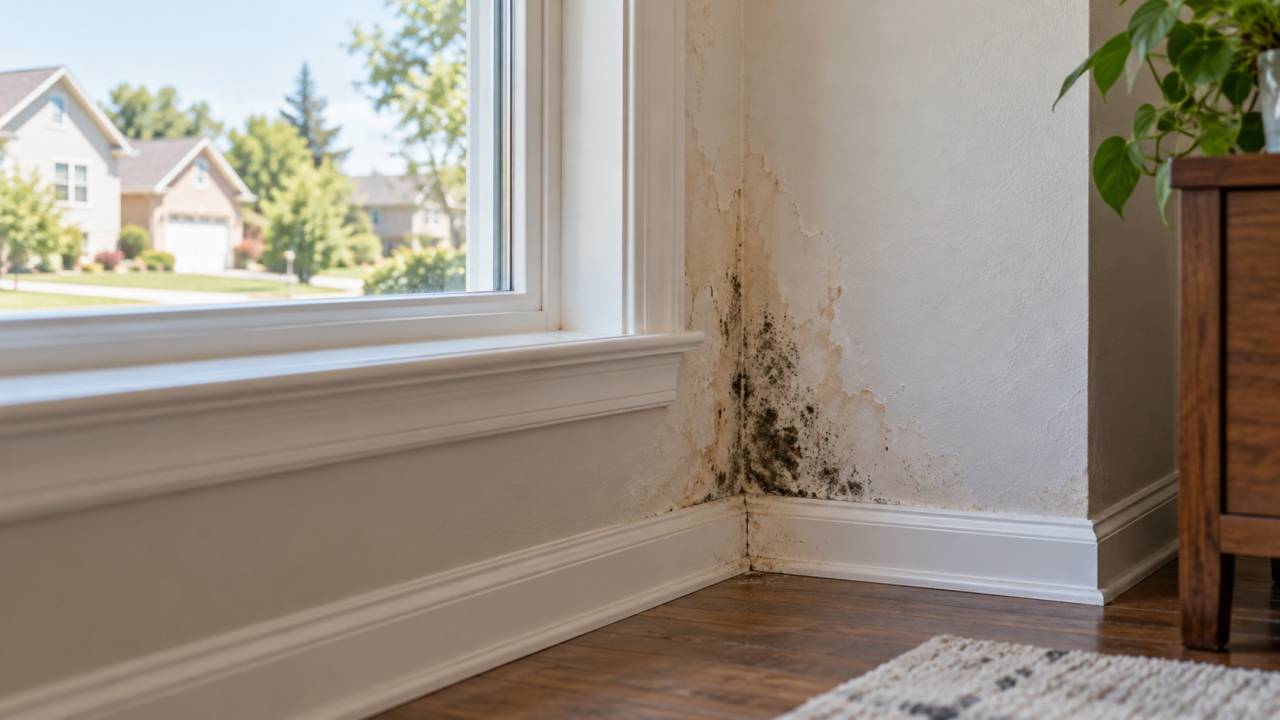
Water damage near a window calls for investigation of the moisture pathway.
Mold concerns in the United States can follow roof leaks, plumbing failures, flooding, damp basements, crawl-space moisture, or condensation. The relevant cause depends on the property. Climate alone does not establish why a particular wall is damp. Inspectors should connect visible patterns with the history of the building and the conditions at the time of inspection.
Do not judge the seriousness or identity of mold by color alone. A dark stain is not a laboratory identification, and painting over a patch does not correct the moisture that supported it. Repeated growth at the same location is a reason to review leaks, drying, insulation, and ventilation. Where contamination is concealed or extensive, arrange a qualified assessment before opening materials. Disturbing affected surfaces can spread debris.
A useful first record includes the room, approximate affected area, when the problem began, whether it changes after rain or air-conditioning use, and what cleaning or repairs have already been attempted. These details help distinguish a one-time water event from an ongoing moisture pathway.
Moisture Investigation: Measure the Building Materials
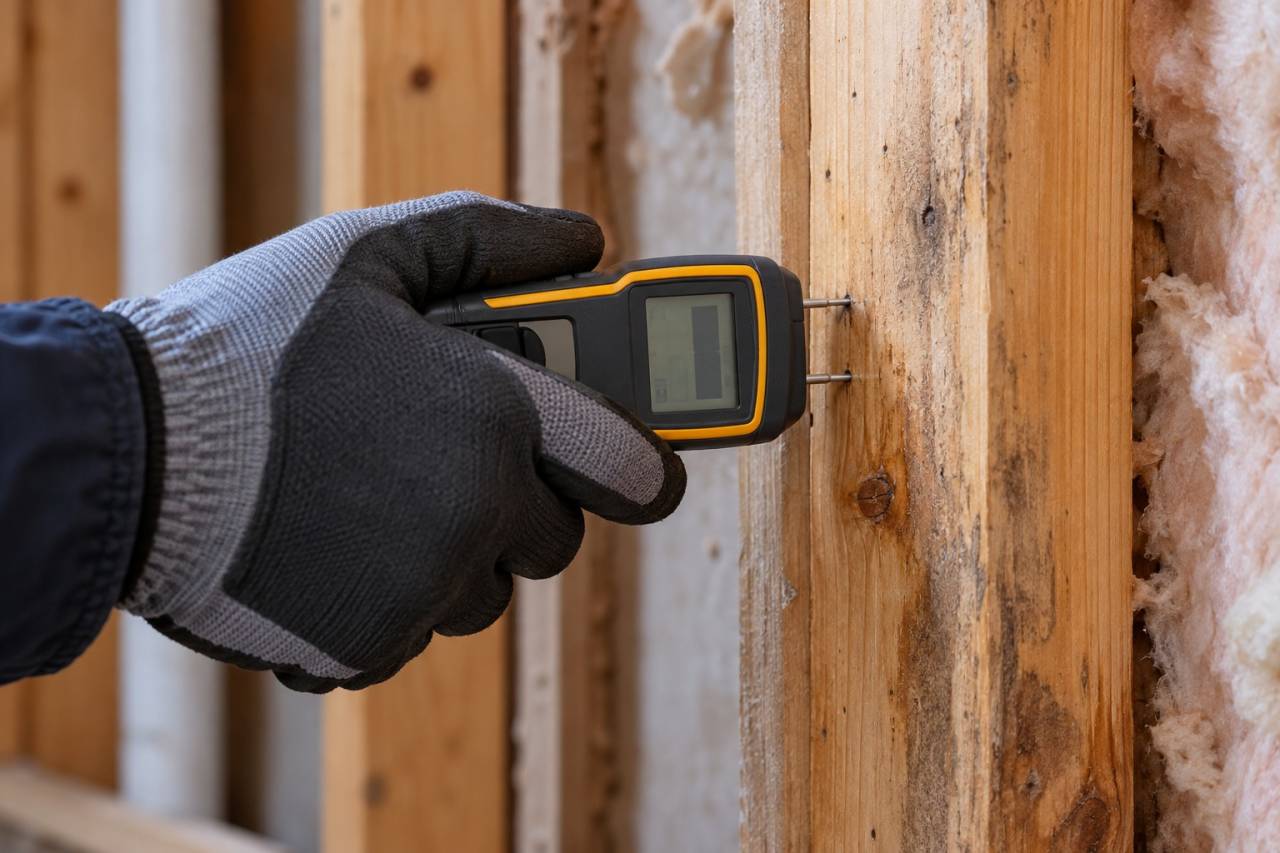
Material moisture measurements help locate damp areas and guide follow-up.
Kabi Busters checks moisture conditions in building materials as part of its investigation services in Japan. A moisture meter can help compare suspect locations with suitable reference areas. The investigator must consider the material, instrument type, calibration, measurement depth, and possible interference. A number from wood cannot automatically be applied to drywall, concrete, or every other material.
The purpose is to trace water and assess whether materials remain damp. Readings should be recorded with their locations and interpreted alongside visual observations, temperature, humidity, construction details, and the water-damage history. A dry surface reading does not necessarily describe every layer behind it.
The resulting plan may involve a roofing or plumbing repair, correction of drainage, review of condensation, or changes to building operation. Appropriate drying and follow-up checks should be planned before finishes are restored. Removing visible growth while leaving a moisture source unresolved can allow recurrence; no single treatment replaces control of that source.
Fiberscope Inspection: Looking Inside Wall Cavities
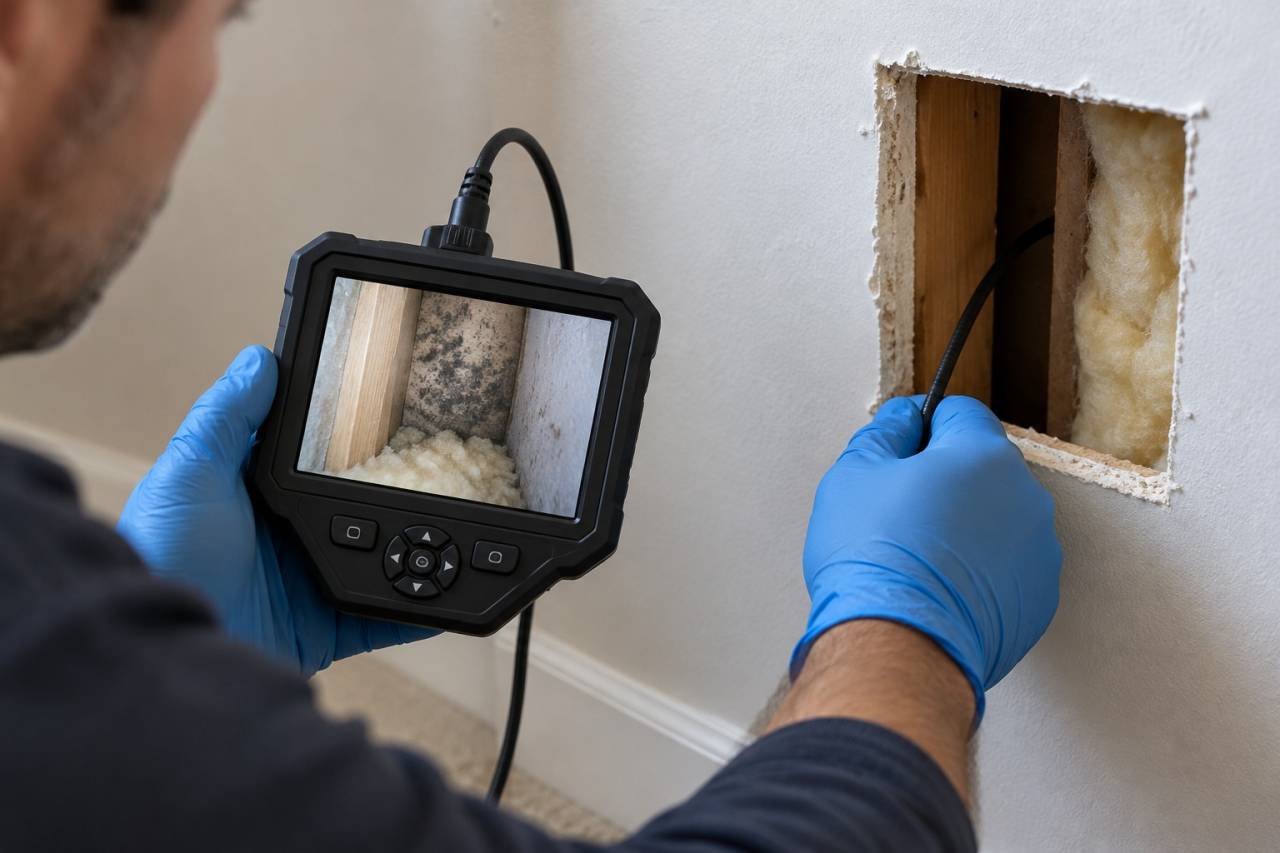
A fiberscope provides a limited view of accessible concealed spaces.
Where appropriate, we use a fiberscope, also called a borescope, to look into accessible wall cavities. The camera can help document selected concealed surfaces without immediately opening a large area. Access must be agreed with the owner and planned with attention to utilities, possible hazardous materials, and containment needs.
A fiberscope is a viewing tool, not a complete survey of the entire wall. Insulation, framing, the angle of the camera, and limited access can hide areas from view. A clear image from one opening cannot certify that all concealed surfaces are unaffected. Findings may justify more targeted inspection by suitable local specialists.
Owners should avoid cutting or drilling into suspect walls simply to take a photograph. An investigation plan should identify where access is useful, how debris will be controlled, and how openings will be repaired. Images and moisture readings are most useful when their locations are documented together.
Airflow and Negative Pressure: Different Measurements
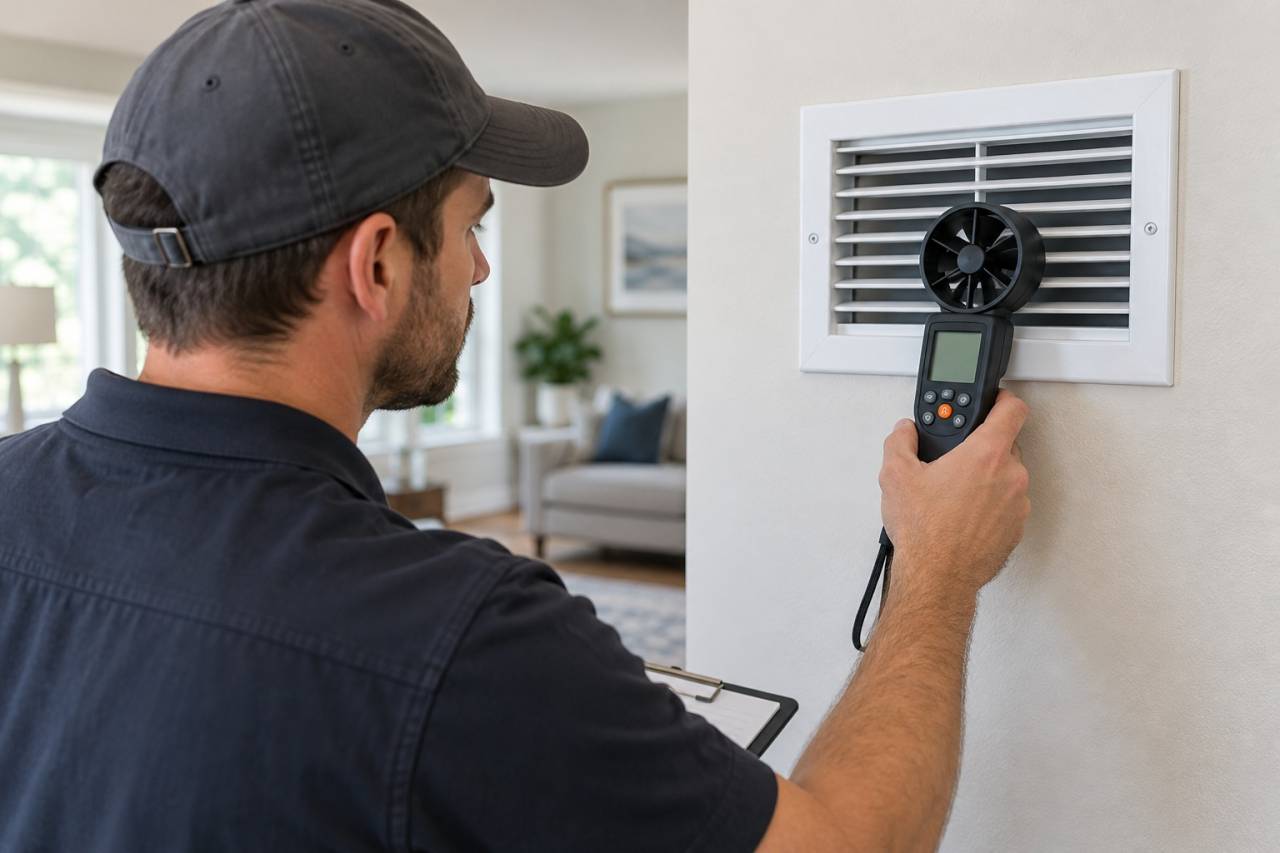
Airflow measurements support a review of ventilation and pressure relationships.
Ventilation and pressure relationships can influence how air moves through a building. Exhaust equipment, supply air, closed doors, and leakage paths may change those relationships. An investigation should consider how the building is operated rather than assume one measurement represents every season or operating condition.
An airflow meter measures air velocity; airflow volume can be estimated or measured with an appropriate method. Negative pressure is a pressure difference and should be measured directly with a suitable differential pressure instrument. We use airflow observations to inform the investigation and distinguish them from direct pressure measurements.
Pressure findings do not identify mold or prove a moisture source on their own. They need interpretation with the building envelope, climate, HVAC operation, and other observations. Where changes are proposed, coordination with qualified HVAC or building professionals helps assess the consequences for ventilation, moisture, and other building systems. The aim is a balanced response supported by evidence.
Fungal Testing and Coordination with Microbial Specialists

A defined sampling question helps make laboratory findings useful.
For people concerned about mold, we recommend a consultation about whether targeted fungal testing would answer a useful question. Kabi Busters coordinates with the General Incorporated Association for Microbial Control (一般社団法人微生物対策協会). The appropriate sampling location, method, laboratory arrangements, and interpretation should be agreed for the project. For U.S. work, local sampling arrangements and any sample-transfer requirements must also be confirmed.
Testing may help characterize a suspect surface or support documentation of defined conditions. It is not a universal requirement before addressing visible growth. The U.S. EPA explains that visible mold generally does not require sampling, and that no EPA or other federal limits have been set for mold or mold spores. CDC/NIOSH does not recommend routine mold air sampling for building air-quality evaluations. These limits should inform any testing proposal.
Results must be interpreted in relation to the collection method, location, timing, and investigation findings. A short sample cannot describe every room or every day. Environmental testing does not diagnose a person's illness or establish a universal health-based pass/fail result. If testing is proposed, ask what decision the result will change and what the method cannot tell you. Repairs should not be postponed simply to wait for a routine test.
Japanese Specialists Traveling to the United States

Overseas support begins with a project review and agreed responsibilities.
MIST Method® Kabi Busters welcomes inquiries about Japanese specialists traveling to the United States to assist with challenging mold concerns. We first review the site information and discuss whether our involvement is appropriate. The possible role may include investigation support, technical consultation, and coordination with local specialists, according to the agreed scope.
Any visit is subject to confirmation of applicable immigration and work authorization, state or local licensing where relevant, insurance, site access, and other project requirements. Equipment, materials, methods, laboratory services, and local contractor responsibilities also need review before work is promised. Japanese experience does not automatically establish authorization to perform every activity in the United States.
Send headquarters the property location, building type, affected rooms, photographs, known leaks or flooding, previous work, and the support you are seeking. We will discuss feasibility, availability, scope, costs, and next steps before a commitment is made. Kabi Busters also accepts consultations across Japan. For a mold problem beyond what you can manage, contact our team so we can consider a practical investigation and response plan.
Investigation tools at a glance
| Tool | Useful for | Limit |
|---|---|---|
| Moisture meter | Locating damp material | Material and instrument affect readings |
| Fiberscope | Viewing accessible cavities | Only the visible field is assessed |
| Airflow meter | Checking air movement | Does not directly measure pressure |
| Differential pressure instrument | Measuring pressure differences | Conditions vary with operation |
| Fungal sample | Answering a defined sampling question | Does not certify whole-building safety |
Frequently asked questions
Do I need a mold test before dealing with visible growth?
Usually not. Start with an assessment of the growth and moisture source. Discuss targeted testing when the result would inform a specific decision.
Can cleaning alone prevent recurrence?
Recurrence remains possible if moisture conditions persist. Repair, drying, appropriate remediation, and follow-up should be considered together.
Can Kabi Busters visit my U.S. property?
Inquiries are welcome. Visits depend on project review, availability, agreed costs and scope, and confirmation of applicable requirements.
Who should I contact about a difficult mold problem?
Contact MIST Method® Kabi Busters headquarters with the location, photographs, and moisture history. See our fungal investigation information for services in Japan.
Public guidance and further reading
------------------------------------------------------------------------------------------------------------------------
カビ取り・カビ対策専門業者MIST工法カビバスターズ本部
0120-052-127(平日9時から17時)
カビの救急箱
【検査機関】
一般社団法人微生物対策協会
------------------------------------------------------------------------------------------------------------------------